Welcome, visitor! [ Register | Login

THE DEATH OF DAVE WINHALL

Editorial August 23, 2022

THE DEATH OF DAVE WINHALL
I J Larivers


I considered Dave Winhall to be a friend. On the (many, but still far too few) occasions I have had to visit the Rifa Conservation Education Camp in the Zambezi Valley on the border with Zambia, one of the things I have always looked forward to is a chance to visit with the resident Professional Hunter – there is no commercial hunting at Rifa, but it is a National Parks requirement that a fully-qualified PH be on hand to guide students’ walks – Dave Winhall and his partner Elspeth.

Dave was a former Rhodesian National Parks ranger for some years before he obtained his PH’s licence. He was a consummate bushman, and I would always try and tag along on his walks with the various school groups circulating through the camp, because I always learned something from Dave.


He had on occasion remarked to folks that when ‘his time’ came, he would rather be killed by an elephant or a buffalo or a crocodile than die a lingering death in a hospital bed. Sadly, his time came on the morning of Tuesday 26 July 2022.

Dave and a volunteer instructor from the Zimbabwe Hunters Association, which makes Rifa possible, had been out on a walk with a group pf youngsters from a junior school in Harare. They had left the camp, and hiked up Shumba Hill, which always has intriguing secrets about the movement of wildlife from the night before to reveal.

As they came down from the crest of the hill and its magnificent view of the mighty Zambezi River below, Dave spotted elephant activity in a small clearing below them. Elephant are sometimes seen at this place, but usually bulls – this time it was a cow herd – always unpredictable. Dave gave the instruction to the other instructor to back off with the students while he (Dave) got the lie of the land. The group of students duly went back along the trail they’d just traversed to await developments.

It should be mentioned that the bush here is thick, even in the dry season, and there are plenty of thorn bushes.


Usually, elephants will move off once they know people are about, and Dave’s colleague heard Dave whistle and shout, and then a shot rang out. The priority at all times is the safety of the school group, and they were kept a safe distance from the clearing while events below unfolded. After a time, the volunteer moved cautiously down, and came across Dave’s body; it appeared that he had been blind-sided by one of the elephants, possibly from the thick bush. Whether the shot he fired was a warning shot to try and turn the charge, or things happened so quickly that he had no time for an effective, aimed shot, is unknown. Extensive National Parks follow-ups did not detect any blood spoor, so Dave’s having shot the elephant is unlikely. But he had had time to chamber another round before he died.


Dave’s volunteer colleague waited by the body for around an hour – at the same time safeguarding the students but not letting them close enough to see the traumatic scene which had played out. As soon as assistance arrived, the legal and medical formalities began.

Counselling was made available to the students who wanted it, and Dave’s remains were quietly transported to Harare and cremated; an elephant attack is never a pretty sight, and Dave’s injuries were extensive; if there is any positive that can come from all this, death was probably almost immediate.


The safety protocols and standard operating procedures that Rifa Conservation Education Camp have put in place to protect the school children in their care were proved by this incident to have been well thought-put and correctly implemented.

Dave Winhall was 71 when he died, fit and healthy (I never could keep up with him in the bush). He had half a century’s experience in the African outdoors that he loved, and throughout his tenure at Rifa, he was living the dream.

I am very sorry that on future visits to Rifa I will not have the pleasure of his company or be able to share another beer with him around the campfire while reminiscing over another fine day in the African bush.

Dave’s life partner Elspeth is a very strong woman, and I can only extend my heartfelt condolences to her, and to Dave’s family.

132 total views, 0 today

HUNTER’S FOCUS: ZIMBABWE

Editorial July 13, 2022

HUNTER’S FOCUS: ZIMBABWE
I J Larivers


FAST FACTS

PROVINCES. Administratively, Zimbabwe’s seventeen million people are divided into ten provinces: Bulawayo, Harare, Manicaland, Mashonaland Central, Mashonaland East, Mashonaland West, Masvingo, Matabeleland North, Matabeleland South, and Midlands.

LANGUAGES. English is the official language of Zimbabwe, accompanied by a further fifteen tribal languages and dialects.

AIRPORTS. Although there are thirteen airports within Zimbabwe, the capitol, Harare, is served by Harare International Airport; other airports which receive regional cross-border air traffic are the Bulawayo Airport in Matabeleland and the Victoria Falls Airport. Immigration formalities are fast and efficient, and Zimbabwean authorities are well-versed in the protocol for processing firearms and ammunition. The same applies to hunters arriving by road from neighbouring countries.


IMMIGRATION FORMALITIES. Entering Zimbabwe is normally an efficient and painless process. Single, double, and multiple entry visas are available to visitors, and most foreign nationals either do not need a visa or can obtain one at the border for a nominal fee. For up-to-date information, either liaise with your country’s embassy in Zimbabwe (there are currently over 50 diplomatic missions representing the major countries of the world in Zimbabwe) or visit www.zimimmigration.gov.zw

THE ECONOMY AND CURRENCIES. The cornerstones of Zimbabwe’s economy are mining and tourism. Currently the US Dollar, the British Pound, the European Euro, the South African Rand, the Botswana Pula, the Australian Dollar the Indian Rupee and the Japanese Yen are all accepted as legal tender, and all major credit cards can be used.


HEALTH. Malaria is endemic to most bush areas within Zimbabwe, and prophylaxis is necessary. Tsetse flies are also common in the lowveld, and contracting bilharzia from water borne activities is also possible. All urban centres within Zimbabwe have good medical facilities, and in the event of a serious emergency, ACE Ambulance operates an outstanding regional CASEVAC facility, in conjunction with Global Rescue in the United States. (Adventure travellers should make a point of checking out the various schemes offered by Global Rescue, who also have detailed information packages on individual countries.) Visit https:/ace-ambulance.com and https://www.globalrescue.com for more information.

COMMUNICATIONS. There are three local cellular telephone service providers who offer very good coverage and competitive rates. Internet is available throughout the country. Iridium devices will work in Zimbabwe.


Zimbabwe boasts some of the most spectacularly beautiful, remote and pristine bush to be found in Africa, together with some of the Dark Continent’s most amazing ecosystems and wildlife.

In northern Zimbabwe, bordering on Zambia, both the iconic Mana Pools and Victoria Falls are designated as World Heritage sites, with the latter incorporating a tremendous amount of history from the bygone days of African exploration. In between lies Lake Kariba, one of Africa’s largest man-made lakes and itself boasting a dramatic history of man vs the powerful god of the Zambezi River, Nyaminyami and the subsequent Operation Noah which remains one of the world’s most celebrated animal relocation exercises. In the southern Lowveld is Gonarezhou National Park, which is part of the Great Limpopo Transfrontier Park, so there is also access to South Africa’s Kruger, and Gorangosa in Mozambique. In the east of the country, bordering on Mozambique are the Vumba and Chimanimani mountains and Nyanga National Park which offer breathtaking landscapes and amazing birding opportunities. In the west, on the Botswana border, lies Zimbabwe’s largest national park, Hwange, which is known for its elephant populations and great animal diversity. Outside of Bulawayo lie two other World Heritage Sites, the Matobo Hills and the Khami Ruins, and in the south, of course, the Great Zimbabwe complex, well preserved, and dating from the late Iron Age.

Zimbabwe’s tourist infrastructure is constantly being upgraded, including many of the original photographic safari camps. The standards are among the best in Africa, and a couple of days spent in pursuit of the fabled tiger fish on the Zambezi River or Lake Kariba is the perfect way to round off an African safari.


Professional hunters and guides in Zimbabwe are among the best naturalists on the continent, which reflects not only a deep and abiding personal commitment, but also a rigorous training regimen. In addition to practical bushcraft and shooting skills, they must display a confident knowledge of bush lore, spoor identification and tracking, vertebrate and invertebrate zoology, osteology, botany, photography, astronomy, conservation and the principles of eco-tourism.

It is because of this intensive training that Zimbabwe is one of the few countries in Africa where guides are permitted to walk with guests within national parks. This activity adds a whole new dimension to the bush experience.


Both the hunting and photographic safari operators in Zimbabwe assist local communities bordering their concessions to benefit directly from wildlife-based tourism. This can take the form of developing schools, clinics, boreholes, and roads, and establishing anti-poaching units and employment opportunities. It is essential that these activities better the lives of villagers, who are living on a daily basis with often-dangerous or destructive wildlife in order to inculcate in them a practical reason for conserving their natural history heritage.


Geographically, Zimbabwe is a landlocked country in southern Africa, bordered by South Africa to the south, Botswana to the west, Zambia to the north, and Mozambique to the east. It has a generally-tropical climate, but runs the gamut from Kalahari sands in the west to montane ecosystems in the east; the southern lowveld is known for its dry, hot weather, and frost – and occasionally even snow – has been recorded in the winter along the higher central plateau. The Zambezi Valley, by contrast, is characterised by extreme, humid, heat. Zimbabwe is a summer rainfall country, with the rainy season generally running from late October / early November to March.

Hunting has played a centre-stage role in Zimbabwe’s history, development and economy since the 19th century. This has not been lost on the government, which takes every step to see that foreign visitors receive the very best treatment. Despite what the tabloid press may occasionally have to say, Zimbabwe is a stable country and the people are very welcoming.


Vast tracts of the country consist of savannah grasslands, though tropical evergreen and hardwood – teak and mahogany – forests can be found in the Eastern Highlands along the border with Mozambique. Iconic of the lowveld are the majestic baobabs, found together with combretum, brachystegia and mopane in huge areas of miombo forest.

Zimbabwe’s wildlife comprises just about everything associated with Africa. From the “Big Five” – elephant, lion, leopard, Cape buffalo, and both the Southern White Rhinoceros and the black rhino – to a rich selection of antelope species: bushbuck, duiker, eland, impala, klipspringer, kudu, nyala, oribi, oryx, roan, sable, steenbok, tsessebe, waterbuck and wildebeest. Other plains game include bushpig, giraffe, warthog and zebra. Both the Brown Hyaena and the Spotted Hyaena occur within the Parks and Wildlife estate, along with cheetah, painted dogs and myriad other species.

Zimbabwe boasts ten national parks – Chimanimani, Chizarira, Gonarezhou, Hwange, Kazuma Pan, Mana Pools, Matusadona, Matobo, Nyanga, Victoria Falls and Zambezi – in which, quite rightly, hunting is prohibited. The National Parks and Wildlife Management Authority maintains well-developed facilities within the estate, and either before or after a safari it is well worth spending a few days in one of the parks, just relaxing, game viewing, or fishing for trout in the picturesque streams of the Eastern Highlands. To get a more comprehensive idea of what’s on offer and where, check out www.zimparks.org .


Sport hunting may be carried out on state safari land, communal (tribal) land, and private land, pursuant to the Parks and Wildlife Act and its attendant regulations.

STATE SAFARI LAND is owned and administered by the government, and forms a part of the Parks and Wildlife estate; it is normally unsuitable for agriculture but good for game. Chewore, Chete, Chirisa, Dande, Matetsi, Sengwa Wildlife Research, Deka and Forestry Land are designated safari areas.


COMMUNAL LAND is that land set aside for and administered by, indigenous people. Rural district councils have a mandate from government to manage and utilise the wildlife in their areas. National Parks assists the district councils to set quotas for hunting off-take of game species, and these quotas are offered by tender to hunting outfitters. Safari operators then market and conduct the hunts, and the trophy fees are paid directly to the rural councils which use the financing to better the lives of the families living in the area. Infrastructural development – like schools, clinics, roads and bridges, and grinding mills – are also funded from hunting revenue. The rural communities see that their wildlife has a sustainable, tangible, dollars and cents value, and that it is in their best interests to protect it from threats like poaching. This system in Zimbabwe is known as CAMPFIRE – Community Areas Management Programme for Indigenous Resources – and since its inception in the 1980s and obvious success, it has even been adopted by some other countries.


PRIVATE LAND used for sport hunting comprises ranch or farmland where game farming may be the sole use for the land, or may be part and parcel of the agriculture business and domestic animals may share the range with wildlife. Game species are more resilient when it comes to drought conditions than domestic animals. Sadly, since Robert Mugabe’s disastrous land reform programme, there are not many private game ranches left, but some Conservancies – such as Bubye Valley and Save Valley – are still extant.

When hunting on private land, you must confirm that the title deeds legitimately belong to the person offering the hunting. Hunters from the United States or European Union could be prosecuted by their own countries for contravening laws prohibiting hunting on re-allocated land which has not been formally sold to the current occupier. Another potential pitfall is the US Specially Designated Nationals legislation, and US hunters are cautioned to first establish that the occupier, owner, safari operator or professional hunter are not listed as such. It is a criminal offence for US citizens to do any business with Specially Designated Nationals. The US Embassy email address is consularharare@state.gov for those who wish to enquire.


By law, safari operators must be licensed by the Zimbabwe Tourism Authority. They must hold a lease on a suitable concession which will have a quota of game approved by the National Parks and Wildlife Management Authority. The operator is responsible for all of the official paperwork and permits required for each hunt.

Professional hunters and guides must be licensed by the National Parks and Wildlife Management Authority, and the licence is renewed annually. Membership in Zimbabwe’s professional association, the Zimbabwe Professional Hunters and Guides Association, is not a requirement for operating as a professional hunter or guide, but both the ZPHGA and the Safari Operators’ Association of Zimbabwe do a very good job of promoting ethical conduct among their members and keeping standards high. It has always been my recommendation to book hunts only with operators and professional hunters or guides who are members. A mine of information, including a list of member operators, PHs and PGs, may be found from www.zphga.org , www.soaz.net, or enquiries to soaz@mweb.co.zw .

It is possible to hunt in certain areas within Zimbabwe with a bow or a handgun, but this requires special licensing. Black powder is also legal provided the firearm complies with the requirements of the Firearms Act.

Zimbabwe’s Parks and Wildlife regulations stipulate the requirements for firearms used to hunt different classes of game. Firearms must have a rifled bore and not be capable of fully automatic fire. Unlike some countries which require minimum calibres for certain species, Zimbabwe bases its requirements on the bullet diameter and muzzle energy as follows:


CLASS A game species, examples of which would be elephant, buffalo and hippo, must be hunted with a projectile of not less than 9.2mm in diameter, and achieving a muzzle energy of not less than 5.3 kilojoules (or 3,909 foot pounds). The .375 H&H Magnum and larger dangerous game cartridges fit comfortably within these parameters, but then so does the 9.3 x 62mm in the hands of a competent reloader. (The late professional hunter and former editor of African Hunter magazine, Dr Don Heath, swore by the 9.3 x 62 for just about every African species.)

Species such as lion, giraffe and eland are listed as CLASS B and must be hunted with a calibre of not less than 7mm in diameter and having a muzzle energy of 4.3 kilojoules (or 3,172 foot pounds).

CLASS C species comprise most plains game such as gemsbok, hartebeest, kudu, nyala, oryx, sable, tsessebe, and waterbuck, but also include leopard, crocodile and zebra. Again, the baseline is a bullet not less than 7mm in diameter, and achieving a muzzle energy of 3.0 kilojoules (2,213 foot pounds).


Finally, CLASS D game, such as duiker, impala, reedbuck, sitatunga, steenbok and jackal, must be hunted with a calibre of not less than 5.56mm, and a muzzle energy of 850 Joules (627 foot pounds).

Your outfitter or PH will advise what calibres are appropriate for the species to be hunted. Firearms for hunting may be easily temporarily imported into Zimbabwe and the requisite licence can either be obtained in advance or your PH will assist you to do this on your arrival. It is preferable to bring your own ammunition, though legal reloading and range facilities are available in Zimbabwe.

For those wishing to hunt with a bow, a draw weight of not less than 35kg and an arrow weighing not less than 45 grams is required for giraffe and eland and draw weight of not less than 35kg with an arrow not less than 40 grams is required for most antelope species. Bow hunting may only take place on private or communal land, and not on any part of the Parks and Wildlife Estate such as in safari areas.


Hunting outfitters are required by law to provide the services of a professional hunter with a current, valid, Zimbabwe licence to conduct hunts involving foreign clients. Licensing is carried out by the National Parks & Wildlife Authority, and Zimbabwe boasts the most stringent requirements in Africa to obtain such a licence. Candidates must write an examination set by National Parks in order to qualify for a learner’s licence, and after successful completion they are then apprenticed to a fully-licensed professional hunter for at least two years. They must, during the course of their apprenticeship, obtain a qualification in first-aid, and successfully complete a rigorous practical firearms proficiency examination administered by the Zimbabwe Shooting Sport Federation in conjunction with National Parks and the Zimbabwe Professional Hunters and Guides Association. Having fulfilled all of the above requirements, there is another examination and a practical proficiency test in the bush, with licensed PHs and other qualified personnel such as National Parks officers, in the roles of clients. Once the candidate has cleared all the hurdles, he or she will be issued with a plastic ID card by National Parks, which will be annually re-validated with a sticker on the reverse side.

Zimbabwe also licenses professional guides, who conduct non-consumptive photographic safaris, though the requirements are basically the same for both licenses, and neither is considered pre-eminent over the other. When you go into the bush with a Zimbabwe professional hunter or professional guide, you are accompanied by the best there is.

Foreign nationals who are not resident in Zimbabwe may not be licensed as professional hunters or guides.

Zimbabwe is known for its excellent wilderness areas for both hunting and photographic safaris, highly knowledgeable and qualified professional hunters and guides, and outstanding animal quality. Once you visit, you will be back!


????????????????????????????????????

136 total views, 0 today

INTELLIGENCE AND UNDERCOVER OPERATIONS IN THE FIGHT AGAINST WILDLIFE CRIME

Editorial July 7, 2022

BOOK REVIEW

INTELLIGENCE AND UNDERCOVER OPERATIONS IN THE FIGHT AGAINST WILDLIFE CRIME
I J Larivers


Back in 2017, I was asked by an NGO which was involved with training for National Parks rangers operating in the Zambezi Valley to create a basic training course for wildlife crime scene management. It was envisaged that the course itself wouldn’t be more than a day long; the main emphasis would be on first-responder anti-poaching teams preserving the crime scene rather than managing it. The Zimbabwe Republic Police has a very capable CID wildlife unit which would carry out any in-depth investigations, together with the National Parks Intelligence and Security section.


As conservation enforcement in Africa was becoming more private-sector, working with the authorities, I had some very good material to look through to augment what I already knew. The gold standard in such manuals is the late Rory Young’s A Field Manual for Anti-Poaching Activities. Sadly, Rory was KIA in Burkina Faso in 2021, while training their government’s anti-poaching units. There is no question he walked the talk.

The main problem I encountered when I started cobbling an aide memoir together was that the scope of any meaningful presentation went far beyond an aide memoir – or a one-day training course.

During Zimbabwe’s post-independence Operation Stronghold, to fortify the Zambezi Valley and other border areas against incursions of poaching gangs, I had worked with the then National Parks Investigations Branch on the covert side – mainly undercover sting operations – but my current business partner, former National Parks warden Chris Pakenham, had done the boots-on-the-ground bit in the Zambezi Valley with the Department’s Tracker Unit. So we had a pretty balanced perspective on both types of operations, but there was a lot of innovative work being done since then, too.


2017 was the year that documentary film director Shaul Schwarz and Christina Clusiau’s Reel Peek Films brought out Trophy, a documentary on the hunting industry in southern Africa. Shaul and Christina said to me that they had a lot of the “normal” pre-conceived First World ideas about blood sports when they first decided on the project. But to their credit, once they were on the ground and getting a first-hand look at the hunting industry, they rose above any ideas they had brought with them, and Trophy is about as balanced as a documentary gets.

A large part of the film centres on the African Conservancies operation in the Omay, adjacent to Lake Kariba.


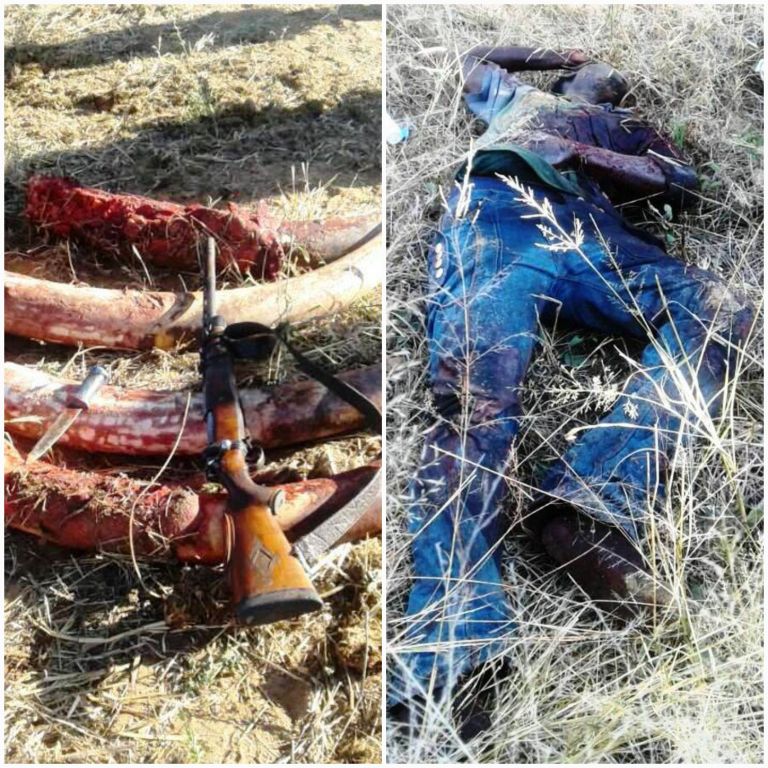
My good friend Chris Moore was at the time heading up the anti-poaching operations there, with great success. He was using pioneering techniques, like “pseudo” teams reminiscent of the Rhodesian Selous Scouts. His teams operated in the Valley using a rusty old .303 rifle and a set of fake elephant tusks expertly crafted by TCI Taxidermy in Bulawayo. They would go so far as laying down cached meat, so they could be on hand to welcome local villagers responding to the tell-tale arrival of vultures. (It should be stressed here that their purpose was only to gather intelligence from the villagers about extant poaching gangs, and not to entice anyone to poach.)

So it was that I decided, with Chris and Chris’s help, to expand on my mandate and bolt together a manual on this facet of wildlife crime enforcement; I had previously not seen such a thing, and, between the three of us we had decades of experience.


The result was Intelligence and Undercover Operations in the Fight against Wildlife Crime. Being a dynamic field, new innovations have come along in the last 5 years, and a second edition is now in the planning phase.


Available from Amazon for $10.00.


https://www.amazon.com/Intelligence-Undercover-Operations-Against-Wildlife/dp/1986524027/ref=sr_1_1?s=books&ie=UTF8&qid=1525776851&sr=1-1&keywords=intelligence+and+undercover+operations+in+the+fight+against+wildlife+crime

PHOTOS

  1. Most die of old age.
  2. Following and undercover sting in Harare.
  3. CID Detective Superintendent Charles Haley scanning a poached rhino with a metal detector.
  4. Bullets recovered from carcasses in the Zanbesi Valley.
  5. CID man undercover as a security guard in an undercover sting in Harare.
  6. Cyanide and oranges: elephant npoaching in the 21st Century.
  7. A poacher who paid the ultimate price in a contact with an anti-poaching unit.
  8. An undercover sting in Harare that recovered a live pangolin.
  9. Illegal rhino horn trafficker just before his arrest.
  10. Cleverly crafted fake elephant tusks for use in sting operations.
  11. Various poaching scenes.
  12. A former Selous Scout and friend in the Zimbabwe Lowveld.
  13. A South Africa rhino horn trafficker arrested in a sting operation in Harare in 2019.

158 total views, 0 today

RIFLING

Editorial July 4, 2022


  • RIFLING
    I J Larivers


  • You can have the biggest and best calibres out there, and the latest state-of-the-art magic bullets, but shot placement is everything. Craig Boddington once said “Mistakes tend to compound themselves and the first mistake usually occurs with the first shot.” He was writing in Bob Forker’s excellent reference book Ammo and Ballistics II, and he was specifically referring to shots on heavy, dangerous game, but if a thing is worth doing, it’s worth doing right. Accuracy – being able to place that magic bullet just where you want it – is a factor of both the ballistics of the combination of rifle and ammunition, and the skill of the shooter. The skill comes from lots of hours spent on the range, and then even more hours spent on the range. It comes easily to some and, to be honest, never to others. So let’s look at the firearm.

    Muzzle energy, sectional density, weight and velocity – they all have their time and place, but a barrel’s rifling is all too often just regarded as an afterthought.

    Rifling consists of a series of helical grooves or cuts running the length of a firearm’s barrel which put a spin on the bullet which gyroscopically stabilises it and improves its accuracy. In theory, as long as the bullet is right for the rifling. The concept has been around for half a millennium.

    Rifling is described as turns in inches, e.g. how many inches of rifle barrel the bullet has to traverse before it completes one complete rotation on its axis. The shorter the distance the faster the spin. What we have to look at when selecting the correct bullet for a particular rifle are firstly the twist rate, and secondly the characteristics of the bullet itself: shape or design, length, and weight (which of course affects length).

    Going back to the old muzzle loaders, where large calibre, short round balls were the projectiles, a very low twist – 1 in 40-50 inches – worked just fine. One of the reasons the old Kentucky rifles had such long barrels perhaps. As bullet design progressed through the Minié ball (named for Claude-Étienne Minié and in no way descriptive of the bullet) to the plethora of modern projectiles available today, the aerodynamic characteristics of bullets improved markedly. As bullet designs became more diverse in terms of weight, shape and bearing surface, so too did bore rifling have to adapt.

    The general rule is that the longer the projectile, the faster the spin required to achieve stability. In the world of commercial ammunition manufacturers, the application is also important. If we take the 5.56mm NATO round as an example, its longer lighter projectiles require a rifling twist of around 1 in 7 or 8 to stabilize – generically but more on that later. A relatively fast spin. I say “around” because a bench-rest rifle shooter or a varminter using the calibre is going to require a greater degree of accuracy and consistency than a soldier. Larger calibre, shorter bullets can make do with, say, a 1 in 16 twist, which imparts a much slower spin. And this, of course, is where handloaders have all the advantage.

    In flight the bullet is subjected to the same vectors as, say, an aircraft in flight. If it does not stabilise, it will begin to pitch and yaw. This obviates accuracy, and occurs if the bullet is not spun quickly enough, or too quickly. On a paper target at close range, this can manifest as “keyholing” where the strike diameter is greater than the bullet diameter and indicates that the bullet was not flying true at the point of impact (note, other factors, such as an improper bullet-to-bore fit, can also cause keyholing). If the spin is too fast, it also adversely affects accuracy and can cause core-jacket separation in bullets and excessive wear on the bore.

    Early shooters using muzzle loaders would select a slightly under-sized ball and make use of a fabric patch to achieve the necessary seal. The patch also afforded another layer of adjustment, insofar as different materials could be used, and “reading” a spent patch to see whether it has achieved the correct fit to the rifling is in itself an art. With the advent of the hollow-based Minié ball, the soft lead bullet base would bell and form the required tight seal in the bore, and pick up the rifling. But one thing the shooter had to know, if he was going for any degree of accuracy, was the correct diameter of his bore so the most suitable projectile could be used. Even today, when the chamber’s throat and freebore – that portion of the throat which is un-rifled – perform the task of seating the bullet into the rifling, the shooter still needs to know his bore diameter.

    Rifled barrels have two diameters – the bore diameter which is the distance between two opposing lands (the high points) and the groover diameter which is the distance between two opposing troughs (the low points). Why is the .303 British of a larger diameter than the .308 Winchester? Because the .303 refers to the bore diameter and .308 to the groove diameter. Both are generically .30 calibre bullets.

    To be effective in improving a bullet’s accuracy, the rifling must be consistent along the bore’s length, it should be polished or cut to a high degree of smoothness so it does not malform the projectile, it must be crowned at the muzzle end so as not to introduce inaccuracy as the projectile exits the barrel, and it must be fitted to the bullet, which must swage into a proper, tight and consistent fit. Given modern engineering technology, this isn’t really a tall order for most manufacturers.

    There are different manufacturing techniques to rifle modern gun barrels. Cut rifling is where a machine tool is used to either cut one groove at a time or all grooves at once down the length of the barrel. Button rifling can be pressed into the bore with a tool called a button, or the rifling can be hammer-forged or flow-forged over a mandrel. (A number of modern manufacturers – especially of handguns – have returned to the concept of “polygonal” rifling that was originally put forward by Sir Joseph Whitworth in the middle of the 19th century. Polygonal rifling is much shallower and less distinct than cut rifling, and is supposed to convey higher velocities, greater accuracy, longer barrel life and whiter teeth. Having extensive experience with a number of Glock pistols before building up another Colt 1911 I was pushed into abandoning cast bullets which lead excessively in polygonally-rifled bores in favour of CMJs; as to greater accuracy, well, I have to fall back on “operator error” for the ones that didn’t go exactly where I wanted them to!

    One of the rifles that hung above the fireplace when I was growing up was an Enfield .303. One of my jobs as the junior member of the family was to make sure the stuff hanging on the wall was cleaned and oiled from time to time. I remember being curious about this old relic that my father had brought home after WWII, because it only had two grooves. It was an Enfield No 4, Mk I. Around three million of these were produced in the US by Savage Arms, whose engineers found the rifles would shoot just as well with a two-groove 1 in 10 twist as with the conventional five-groove 1 in 10 configuration and the two-groove models, marked “US Property”, were easier and cheaper to produce. Who knows whether that was just spin – no pun intended – or not? After the war, the two-groove concept fell away.

    An 1858 Enfield Tower musket I once owned also had two-groove rifling – where any was left. And even with eroded rifling in places it was “good enough for government work” as a casual plinking rifle with a 480gr Minié mould I imported. So yes, the number of grooves is also variable. The be-all and end-all of accuracy is probably achieved by bench-rest rifle shooting, and when I put the question “What say you?” to Zimbabwe’s champion bench-rest shooter Roscoe Dickinson, he replied:

    “The facts, as best I know them, are that nobody produces a two-groove barrel any more. It would appear that the barrel industry has standardised on a set of grooving for the most part. In smaller calibres this is four-groove going up to eight-groove for the .50 calibres. Within this there are various manufactures that produce alternate rifling patterns other than the “standard” square rifling such as 5R and polygonal. In respect of bench-rest Hart Barrels do produce three-groove 6mm barrels in 14:1″ twist rate. The “best” barrels, as currently regarded, are all 4 groove in 6mm.”


  • So the number of grooves would seem to be more about production processes and less about accuracy, as I thought.

    In order to keep productions costs in line, the majority of rifle barrels have a constant twist rate along their length. There is, however, a process called gain-twist rifling, whereby the spin rate is increased along the length of the barrel, after the bullet has engaged the rifling. This means that the projectile’s torque is more evenly distributed along the barrel’s length. It supposedly improves velocity and accuracy, but its main benefit is probably in prolonging barrel life by reducing erosion in the throat area. Like the concept of rifling itself, gain-twist rifling is nothing new; it dates from the US Civil War, and possibly earlier. It requires more complex manufacturing processes, and is consequently more expensive – and in any case in today’s world of extreme precision in machining techniques and exacting tolerances, the concept of gain-twist rifling is probably a complicated and expensive solution to a no longer existent problem.

    Now, you have to ask yourself whether you will move heaven and earth to ensure that you always, until the end of time, will have exactly the same components for your particular rifle once you’ve found your optimum load – as a bench-rest shooter would – or whether, like a hunter, you are going to experiment with different bullets and powders. You can optimise either for a certain projectile or for a barrel that will give good performance with a wide range of bullets. I’m guessing most folks – apart from long-range varminters and bench-rest afficionados – will choose door number two. The true cognoscenti will, of course, have a perfectly good excuse to rush out and buy a lot more guns!

    One of the reasons I have selected the 5.56mm NATO calibre as an illustration here is because of its popularity both as a military and a sporting cartridge.


  • A note here – the 5.56x45mm NATO is not exactly the same thing as the .223 Remington. 5.56mm ammo can generate higher pressures in .223 chambers (and therefore malfunctions), and the length of the throat (or leade) of the 5.56 chamber is longer than for the .223 and if the bullet comes in contact with the rifling too soon pressure spikes can result. In a nutshell, milspec 5.56mm ammo is best shot through a 5.56mm rifle, which of course can also fire the .223 safely. If you are only going to work with .223 Remington, then that may well be the correct choice for you.

    Lumping them together for the sake of my purpose here, the calibre is in widespread use as a military cartridge, in International Practical Shooting Confederation 3-gun matches, and as a light hunting rifle. So what application are you looking at? In a heavier and more powerful military configuration like the 77gr MK262 you would want a fast twist like a 1 in 7. The lighter (and shorter) 55gr commercial loads can work well with a 1 in 9, and if you go for a really light varmint bullet like Hornady’s 35gr NTX, you’ll possibly be quite happy with a 1 in 12″twist.

    “Can work well”? “Possibly be quite happy”? Well, we haven’t looked at all the other factors that go into making up a truly accurate round, so you’ll just have to sit down at the loading bench and make a few forays out to the range to see what works best in your rifle for your intended application.

    Without wanting to sound overly condescending, given the IPSC rifle matches I’ve seen, it’s all Formula 1 stuff and based on kit more than application; many competitors, charging as close as they can to the targets, don’t seem to grasp the fundamental difference between a rifle and a pistol. The late Col Cooper would no doubt be nonplussed. With an “A” zone on the target the size of a small pizza box, the term “good enough for government work” truly comes into its own. Bench-rest shooters and varminters will demand more precision, and, as Edd Woslum, owner of Evolution, USA, one of America’s finest custom rifle manufacturers puts it, repeatability, from their rounds.

    You have to consider what your specific requirements are. Perhaps you can’t sit down like Edd and manufacture a fine custom rifle for every bullet offering on the shelf, but an appreciation of rifling and how it works – together with all the other concepts that make up handloading – will help you get the very best performance out of what is available to you.


164 total views, 0 today

CANOEING THE ZAMBEZI

Editorial June 27, 2022

CANOEING THE ZAMBEZI
I J Larivers

At 1,600 miles, the Zambezi River is Africa’s fourth largest, and the longest watercourse that flows eastward, into the Indian Ocean. The Zambezi River basin comprises over half a million square miles of God’s Own Country, arising in Zambia and flowing through or bordering on parts of Angola, Namibia, Botswana, Zambia, Zimbabwe and Mozambique, whence it opens out into a huge delta, before finally emptying into the Indian Ocean. The Zambezi is noted for the magnificent Victoria Falls, and two ambitious hydroelectric schemes, the Kariba and Cahora Bassa dams. Along the border with Zambia to the North and Zimbabwe to the south, the mighty river flows through two stunning gorges, the Kariba and the Mpata. 35 years ago, my good friend Nigel Wentworth-Browne and I canoed the river from the base of the Kariba Dam wall, to the border town of Chirundu.


The Kariba Gorge borders Zambia and Zimbabwe, and the chasm which remains today is but a vestige of the depression that was filled by Lake Kariba after the dam wall was built, creating the world’s largest man-made lake (by volume) over the period 1958-1963.


A large number of Tonga people were relocated from the gorge after the dam wall’s completion, and between 1958 and 1964, Operation Noah was undertaken by the Rhodesian government and led by Rupert Fothergill, to rescue wildlife trapped by the rising waters. More than 6,000 animals were extracted, and the majority were released in what is today the Matusadona National Park.


Before the construction of the Kariba Dam, and before the 20th century caught up with the Kariba Gorge, the Tonga people were protected and shepherded through difficult times by the god of the Zambezi Valley, and the river in particular, Nyami Nyami. With the head of a fish perched atop the body of a snake, Nyami Nyami wasn’t one to mess with. When he was having a bad hair day, it was the role of the spirit mediums and tribal elders to attempt to appease him on behalf of the villagers. The river god is believed to reside in the dark waters of the Zambezi, and he was in high dudgeon when construction of the dam wall began; the Tongas believed that the lake would separate him from his wife, so you can see his point. A couple of unusually robust floods which brought the construction of the dam wall to a standstill, and the human collateral damage that would be expected from such a large undertaking in the primitive conditions of the African bush cemented Nyami Nyami’s street creds no end. But eventually the dam wall was completed, the lake was filled, and pretty much everybody but Nyami Nyami lived happily ever after. Today, the 20+km ravine which extends from the base of the dam wall to Nyamoumba, where the river flows out onto a huge floodplain, is all that remains of the original gorge downstream of the dam.


Back in the late ‘80s, though there were commercial canoe safaris operating on the Zambezi, it was easy enough to go to National Parks in Harare and get a permit to do your own thing from the Warden, Tourism, Anne Moore. That done, Nige and I secured the canoe to the top of his beach buggy, and we drove to Kariba where we overnighted, if I remember, at the M.O.T.H. chalets, quaint and comfortable. The next morning, we arranged porters to carry the canoe and our camping gear down into the gorge at the base of the dam wall. The sun had not yet risen, and the spring air was chilly. From the top, some really big crocodiles could be seen lazing in the pool at the base of the dam, where they wouldn’t have to work too hard for the remains of any fish coming out of the turbines. The water was dark and calm, though every now and again a large eddy might appear, and together with the crocs holding station out in the pool, they served as a reminder that once on the river, Nyami Nyami himself was still very much the boss.


The commercial canoe safaris would usually get through the Kariba Gorge on the first day, and set camp a a designated spot on the floodplain; whether that was necessary in terms of their permits I don’t know, but to Nige and I, the gorge was the main attraction, and we spent the first three nights within its striking confines. The idea wasn’t to put distance behind us, but just to drift along, enjoy the panoramas, and if the following night’s campsite was only a few kilometres from the previous one, who cares?


On the first day, we rounded a bend, and a small tributary came in from the south. A large sandbank extended out well into the river, and the first thought that came to mind, seeing a small pod of hippos in the shallows by the sandbank, was Chessa! Being small-mouthed fish which would likely be in the presence of the hippos. We had noticed a couple of crocs just floating on the surface mid-river, holding station, and as we anchored the canoe on the sandbank in a few inches of water, we made mental and verbal notes to keep a constant eye on them. The hippo had dispersed into deeper water, and we tried our hand on light tackle where the small stream came in. After a couple of hours, we had caught a number of squeaker, and that was about it. The squeaker is a type of catfish with a long, bony skull, and sharp barbs protruding from the dorsal and pectoral fins. It squeaks and grunts when removed from the water, and care must be taken not to get speared by one of the barbs.

????????????????????????????????????


Gradually, we’d worked our way out along the sandbank where it disappeared into the fast-flowing current of the gorge, hoping for a tiger fish or two, and of course we’d forgotten all about the crocodiles. There are instances in probably everyone’s life that seem to push their way to the fore should you awaken from a deep sleep in the middle of the night. That compel you to think – and sometimes say convincingly out loud – “It didn’t happen! Forget about it!”. That prevent you from dropping back off to sleep until they have been relegated back where they belong in the deeper recesses of your memory. Looking down into the river, probably a foot or two in front of me and locking eyes with a crocodile is one of those instances for me. It wasn’t a big one – maybe 6 or 7 feet – but it would have been big enough had it been seriously intent on a meal. Do crocodiles get curious? Probably not, for they haven’t really changed in over a hundred million years. They’re just feeding machines; all I know is that I re-learned a lesson I already knew, and that was never to put myself in that kind of a position with one. As an aside, walking on water? I found that it’s not really all that difficult.


That evening, we pitched our bivvys on a sandbank. The squeakers were labour-intensive, requiring pliers to remove the skin and leaving only a couple of thumb-sized fillets, but the meat was delicious; I’ve never thrown a squeaker back since. A couple of scotches while somewhere above the gorge a lion was vocalizing, and a good night’s sleep.


We were only on the river for five nights, and so we had brought bacon and eggs for the first morning; breakfast dealt with we carried on, drifting, fishing, and exploring any interesting-looking features along the way.


When we finally arrived at the end of the gorge, we made our last camp just inside its walls. Mooring the canoe to a large boulder which looked like a good place to try for some tiger, Nige noticed a baby boomslang, not more than maybe 6-8 Inches long, staring at us at eye-level from a small bush and pretending very hard not to be there. In the afternoon we paddled out to some rocky islands which had had potholes eroded into them over how many hundreds of years we could only guess. We cast a couple of lines out into the current for tiger and excavated the contents of a couple of the holes. Underneath a few inches of sand, at about arm’s length, I recovered an old fork, with “GS”, for “government service” stamped into the handle. While my tiger fish was busy unhooking itself.


The morning of the next day, our penultimate one on the river, Nige caught a frog just as the sun rose, put it on his hook, and hauled in a very nice tiger.


I took a photo of what appeared to be an unusual cloud formation building up over Zambia as we headed out into the floodplain. As we drifted along, it grew into the stuff of which 40 days and 40 nights legends are made. We pitched camp on one of the larger islands in the river as it started to rain, and feasted on canned ham and dry biscuits. It was impossible to keep dry, but it wasn’t all that uncomfortable. The next day a couple of hours of determined paddling took us to Chirundu, where the beach buggy had been left for us. The rain carried on, gently, for some days.

Chirundu was to be the staging point for our next canoe trip, through the Mpata Gorge, down to where Zimbabwe, Zambia and Mozambique all converge, but that’s another story.


The trip was primarily a break; a good excuse to get out of the city and see some new places. But I’d also been tasked by Graham Nott, the chief of investigations for National Parks, to use the excursion to get a feel for the area. Especially between the Red Cliffs at the downstream end of the gorge, and Kanyemba where there was a lot of cross-border traffic, legal and otherwise, with the village of Luangwa in Zambia. High on the list of priorities was making contact with Zimbabwean and Zambian fishermen who might be groomed into passable confidential informants who could provide intelligence about incursions of ivory-poaching gangs and the cross-border traffic in illegal ivory and rhino horn. These were the days before cellphones, but we would send in experienced informants from time to time who would surreptitiously make the rounds of the local villages and talk to the locals who knew things.

We’d taken advantage of the “work” aspect to draw an AK-47 and a couple of Parks VHF handheld radios, but the best piece of kit, which was made available by Chris Pakenham, the warden at Darwendale, was one of the Parks aluminium canoes with a stern transom so we could take a little 3hp motor just for in case. This also makes heading back upstream, if necessary, a lot easier. Chris had work in the Valley, and took us to Chirundu in the station Unimog.


Neither of us had previously had any experience with aluminium canoes, but we quickly found they were very different to the more common fiberglass ones in that they weighed almost nothing, and that buoyancy translated into instability unless they were appropriately loaded down. Crocodiles no doubt daydream about a couple of idiots falling out of a canoe as they lazily bask their lives away on the river’s myriad sandbanks. Fortunately, with provisions for five nights plus, the canoe settled down nicely when we’d packed it.


It was late morning when we launched from the old police jetty at Chirundu, and we had resolved to get below where the Kafue River comes into the Zambezi from Zambia before we started looking around for a campsite. It was nice just to be on the water, and we set out a couple of lines for whatever might be biting, and just drifted with the current. Traversing Zambia, the Kafue is the Zambezi’s biggest tributary, and we passed where the two converge and found a nice campsite under a couple of Faidherbia albidas. Except they weren’t Faidherbia albidas then, but that’s another story. We’d shaken down the canoe that afternoon, but we had to unpack it every evening and portage it up to where we were camping. Especially with that little 3hp motor. Zambians like nice things too. The campsite was pretty nondescript, but we cooked up some nice T-bone steaks with fresh vegetables – something that we would only be able to do for the first couple of days – and toasted the sunset over Zambia.

Days on the river tend to merge together, so relaxing are they, and by the end of the second day we’d made a few new friends of some Zambian fishermen with whom we’d swopped some hooks and line, and contact details. They would think nothing of coming across to the Zimbabwe side to meet with one f our guys at a later stage if so arranged.

Just after lunch, we picked up a stalker. Back in the ‘90s the river’s hippo population seemed a lot more chilled than it does now. Probably just less traffic on the river. But they are essential to watch out for. Somewhere between the Sapi and Chewore areas, we noticed a young hippo pop his head up about 30 or so metres behind us, and fix us with what, to a hippo, was probably a baleful stare. We must’ve floated (we never used the motor unless absolutely necessary) right over him, and we saw no signs of any others in close proximity. He wasn’t very big at all. Whatever his life story might have been, we paid him no further attention as we started looking for the evening’s campsite. He, on the other hand, pretty much kept station for the next hour or so, popping up periodically to check us out. He didn’t come any closer, but definitely seemed to have an obsession. Even after we’d found a campsite he hung around for awhile, but there was neither hide nor hair of him the next day.

We finished the last of the fresh provisions with an early dinner, and eagerly anticipated the next day – the Mpata Gorge was in sight. In the early evening the sound of drums floated across the river from Zambia. It’s a sound I love, but we were still mindful of the possibility of nocturnal incursions across the river and the loss of gear. We hadn’t glassed the opposite bank in good daylight, so we didn’t really know what was there. Now, a thunderflash is a very useful thing to have along in the bush. We had packed away a couple of the “new” ones which Major Bob Cox was making up for National Parks. Gone were the old black powder tubes I was familiar with. These were plastic bottles such as medicines come in, filled with ammonium nitrate with a match-head detonator attached to a length of Cordtex. Nige tossed one of these out onto the river in the gathering dusk, and it went off with an almighty concussion, echoed back by the mouth of the gorge. There was quiet from the other side of the Zambezi. The next morning, we set up a proper spotting scope on a tripod and scanned the Zambian bank. What we saw when we looked hard was a safari camp – the poor guests were probably just being called to dinner the previous evening!


The Mpata gorge is a stretch of the mighty Zambezi River that is even more spectacular than the Kariba Gorge. The water level was low, which exposed a lot of rocks that could otherwise be submerged, and made the gorge even more prepossessing.

Only a few hours’ paddle from the impressive Red Cliffs on the Kanyemba side, we chose to spend a couple of nights within the confines of the gorge; again, squeaker were the most common fish, and we could easily catch enough for an evening feast. During our last night in the gorge, a storm front moved in from downstream. We awoke to grey, overcast skies, and the river had developed a chop from a stiff breeze coming upriver. We chose to stow a few ballast stones in the bottom of the canoe to give it a little more stability.

Once out of the gorge on our penultimate day in the Valley, we drifted, rather than paddled, the short distance to Kanyemba. Past where police senior assistant commissioner John Chademana had poached the buffalo that ended his career in a well-publicised trial a few years earlier, and where we had fished and explored on a couple of previous trips to Kanyemba.

Kanyemba now boasts a number of fishing and safari camps, though in those days the only amenities were a couple of ramshackle chalets glorying in the name Falcon Lodges, and “administered” by the District Development Fund. They were in poor condition, but we hired a couple of children to clean them out for us, and heat some water. I’d brought along an old Ruger Blackhawk revolver in .357 magnum that by then was full of sand, so I siphoned off some paraffin from one of the lamps, stripped it, and cleaned it whilst watching a magnificent sunset and enjoying a 12 year-old Tobermory Malt scotch, which I’d become addicted to during a visit to the Isle of Mull some years previously.

Just a little ways further downstream was a police camp, and I wished I’d gotten the chance to visit Luangwa, across the river in Zambia, for there was a rich history there.

At the end of the 19th century, John Harrison Clark styled himself “Chief Changa-Changa”, King of the Senga. One frequently-told story is that he was forced to flee the Cape colony as an outlaw after having accidentally killed a man. Who knows? It was the time of legends, and he was the sort of character that would come to attract a mystique surrounding him. Whatever the reason, his wanderings took him to Portugese Mozambique, and he followed the Zambezi River upstream to the abandoned village of Feira, where the Luangwa joins the Zambezi. Now called Luangwa, and known to Livingstone, Feira had been founded by Portugese missionaries as probably the first European settlement in what is now Zambia, sometime around 1820. By1887, when Clark arrived, it was a ghost town. Deserted after a native uprising decades before, it had never been re-occupied. Its emptiness apparently suited Clark, and he took up residence, flying the British Merchant Navy’s red ensign above his boma.


As he was the only one thereabouts with his own army, Clark levied and collected “taxes” in the form of cattle and other livestock from the African villagers and sold “trading licenses” to foreign merchants, reaping ivory, gold and other trade goods in payment. In the case of ivory hunters, his “export tax” was half of their bounty. He also defended the local villagers and colonial traders from slavers and marauders.

The following morning, we were uplifted, and made the trip back to Harare. Wishing we weren’t.

142 total views, 0 today

THE PRIVATISATION OF ANTI-POACHING

Editorial June 22, 2022

THE PRIVATISATION OF ANTI-POACHING
I J Larivers


Much has changed in the Zambezi valley since 1985 when Zimbabwe embarked on Operation Stronghold, a paramilitary operation by the then Department of National Parks and Wildlife Management under Chief Warden Glen Tatham, in cooperation with elements of the Zimbabwe National Army and Zimbabwe Republic Police to curb incursions by heavily armed poachers who crossed the Zambezi to poach primarily rhinoceros. In the first two years Operation Stronghold accounted for 29 poachers killed in contacts, 22 captured, and an undetermined number wounded. There is no question that Stronghold turned a tide which would otherwise have driven Diceros bicornis to extinction throughout most of Zimbabwe. As population figures would later show, it was probably already too late to save most of them.

Following on, in 1992, Matusadona National Park, bordering on Kariba’s vast Eastern Basin, became one of the original Intensive Protection Zones for the black rhinoceros. Matusadona, a 1,400 km2 expanse of rugged terrain bounded on the south by the Omay communal area, on the north by Lake Kariba, on the east by the Sanyati River and its gorge, and on the west by the Ume River was made into a national park in 1975. Its three primary ecological zones comprise the lake and its grassland foreshore, the Zambezi valley floor made up of a mass of thick jesse bush and mopane woodland, and the escarpment which consists of Julbernadia and Brachystegia woodlands. It is unspoiled natural beauty at its finest.


The Intensive Protection Zones were an attempt to try and preserve the remaining black rhino by capturing as many animals as possible from the Lower Zambezi valley where they still remained at risk and move them to safer areas. Together with Matusadona the other IPZs were Sinamatella, Chipinge and Matopos.

As time passed, the rhino populations still continued to be poached, but with the burgeoning Chinese and Vietnamese footprints in Africa, the elephant were next, being slaughtered for their ivory. This was happening against the background of a deteriorating national economy, and the halcyon days of programs like Operation Stronghold had passed. It became clear that it would be more and more up to the private sector to spearhead the Rhino and Elephant Wars.


Today, the nominal responsibility for safeguarding Zimbabwe’s natural history heritage lies with the National Parks and Wildlife Management Authority, which has morphed from its previous incarnation as a government department. This gives the illusion of autonomy from government, which is what the powers that be know the animal rights activists overseas – with their desired cash injections – want, but in reality as the Authority is wholly government-owned it’s just prestidigitation. All the money goes to the government anyway, and is largely siphoned off for operations with a more political agenda. Bottom line? National Parks is broke. Because it has no money, the impetus for looking out for the country’s wildlife has fallen largely to the private sector. There is good news, however, because unlike in countries like Kenya where government policy is driven by the “Donate now!” brigade of high-profile first world animal rights “charities”, in Zimbabwe a lot of the initiatives are directed by local organisations.

Lake Kariba alone has seen a number of such enterprises launched in the past few years: the Matusadona Anti-Poaching Project, the Tashinga Initiative, the Gache Gache Wilderness Area Anti-Poaching Unit, the Kariba Animal Welfare Trust, the Kariba Conservation Programme and African Conservancies are probably the most active. They work concurrently with the National Parks and Wildlife Management Authority, and the CID Minerals and Border Control Unit of the Zimbabwe Republic Police. Other non-governmental organisations like the Zambezi Society and Flying for Wildlife cast a slightly wider net throughout the Zambezi Valley, and of course there are the conservancies in the Lowveld like Save Valley and Bubye Valley. Bubye Valley is home to a third of the world’s remaining black rhinos, and their anti-poaching infrastructure is akin to a small private military company. It has to be, or there would be no rhinos left.


The Matusadona Anti-Poaching Project has been very successful since its inception in 2013 in soliciting the support of a number of corporate sponsors, whose support is channelled through a board of trustees to administration, lake-based, and land-based operations. The very fact that community support can be had at all given Zimbabwe’s dire economic straits is both almost incomprehensible and a testament to a country that values its wildlife resources.

MAPP’s lake-based operational area extends from Sanyai East to Tashinga and the Ume River. They mount vigorous lake-borne boat patrols together with logistical support for call-signs, and work hand-in-hand with the local communities in a hearts-and-minds approach to conservation. This encompasses creating and controlling a network of confidential informants and working closely with the village chiefs and headmen to provide valuable education-extension so the locals will develop an awareness of the reasons for preserving their natural history resources. Lastly, the lake-based units provide support for the land-based operations, and vice-versa.

The land-based operational area comprises the Matusadona National Park, and the area from the Sanyati River to the Ume River, encompassing the rural villages. Roads are built and maintained to provide necessary access, anti-poaching teams are deployed, together with logistical support, and it is envisaged that an aerial reconnaissance programme will soon be in place. Again, confidential information sources are cultivated and the local hierarchy is involved to get the conservation message across and government liaison is maintained at regional and head office levels.


MAPP’s basic infrastructure and standard operating procedures are similar to those of most of the private environmental groups, and in addition to the basic infrastructural development of areas, undercover stings are mounted against illegal wildlife traffickers and armed anti-poaching patrols are carried out. This is where the government liaison is critical, because with poachers and traffickers facing minimum mandatory prison sentences of nine years for offences involving specially protected species like rhinos, elephants and pangolins they literally have nothing to lose from initiating a lethal firefight. Poachers often operate in squad-sized elements and are armed with automatic weapon systems; they like as not may be serving members of the security forces, with specialised combat training, so it’s no joke.

I say SOPs are similar, but there is still the need for a lot more coordination. In February of 2016, some of the stakeholders got together in Harare to discuss just that. There were over sixty people on the mailing list. The need for better coordination between NGOs and National Parks was graphically demonstrated a couple of months later when the well-known and respected professional hunter Claudio Chiarelli and his son Max were killed in a friendly fire incident with National Parks rangers in Mana Pools National Park.


At the end of the day, you need meaningful deterrent sentences like nine years, and you have to accept that this raises the stakes to the next level; at the same time out of economic necessity you have the butcher, the baker and the candlestick maker from the private sector doing a job that in a perfect world would be carried out by law enforcement and military personnel. Because of this paradox, Claudio and Max’s deaths glaringly point out the need for better training, synched standard operating procedures and communications, and coordination of efforts.

Denizens of the Internet lost no time in waxing lyrical about the fate(s) that should befall the rangers who opened fire killing Claudio and Max Chiarelli, but since few if any of them had probably been boots-on-the-ground under similar circumstances they fail to appreciate how easy it can be for over-worked and under-paid operators to make that kind of mistake under the stress levels they experience daily. Rather concentrate on lessons learned and move forward.

In another instance, a little earlier in the year, a combined National Parks Investigations and CID team from Harare deployed to Nemangwe village in the Zambezi Valley accompanied by a would-be rhino horn and ivory trafficker, who had produced WhatsApp photos of both ivory and horn sent from his brother who was on the ground in the area. By midnight, a “very smelly” (read fake) rhino horn had been recovered from a hiding place in the bush but the sellers wouldn’t even show it until they had seen the money. The premise had been that for safety’s sake the money would remain in the town of Gokwe, which was about 90km away. That is where the police arresting details were positioned. The two Parks and CID details who had gone to Nemangwe knew the horn was a fake and sensed a robbery attempt. It was midnight, and neither the Parks or CID vehicle back in Gokwe had the fuel to deliver the supposed money to the trap. The whole excursion, based on what was seemingly good intelligence, had been a waste of time and scarce fuel allocations. But that wasn’t the end, of the story.


Working on information from another CI altogether, a CID and Parks team out of the regional office at Chinhoyi found themselves in the same village a couple of days later together with volunteers. The traffickers this time around produced the ivory, but a gunfight ensued when the trap was sprung. Whether it was the same lot of sellers or not, the story of the buyers driving off a couple of nights before had clearly gotten around. One CID man was wounded and one of the traffickers died of gunshot wounds. Ensuing publicity highlighted “how dangerous these operations can be”, but they can be a lot more dangerous if they’re not coordinated. The Harare team wasn’t aware of the Chinhoyi team, and vice versa, because of different informants. It could just as easily have been the two undercover teams shooting at each other, because they would each have assumed the others to be the sellers. And in passing I don’t believe there should be any publicity at all, or the bare minimum, when undercover operations are involved, but of course the whole question of funding comes up again, because donors love to read about stuff like this.

I can’t express how much I admire those folks who have come forward and stepped into the breach to try and stem poaching. These initiatives are outstanding, and have undoubtedly saved much of the country’s wildlife. This private-sector involvement is also responsible for seeing the introduction of new technology, like K9 units, which government could not afford to establish. But even for the private sector a lot more funding is needed. It is worth noting that among the sixty-odd folk invited to the February stakeholders’ meeting, the majority were professional hunters.


It should come as no surprise that the safari industry pays most of the bills. That industry, and its funding is now under threat from the first world keyboard warriors of the animal rights movement. Animal rightists – in this case fronted by the British organization LionAid – wouldn’t allocate a cent to Bubye Valley, because they are a prime lion hunting destination. LionAid views the recent French and American moratoriums on the import of lion trophies as a great “victory”. But the revenue from legal, controlled, lion hunts paid for much of Bubye Valley’s rhino conservation. So what has emerged is a bizarre parody of its equally ridiculous American primogenitor: “Lion Lives Matter” if you will. And presumably, at least as far as LionAid seems to be concerned, the hell with rhino lives. So without the hunting industry – often sticking up for species they can’t even hunt, like rhinos – even the bulk of the private conservation initiatives would flounder.

So there is private sector and then there is private sector. Africa’s wildlife doesn’t need the ministrations of the big animal rights charities, but as governmental infrastructure continues to deteriorate across the continent and the activists try and exert more control over wildlife policies, it desperately needs the intervention of initiatives like MAPP and all the others out there like them.


145 total views, 0 today

IN PRAISE OF STANDARD EXERCISES

Editorial June 20, 2022

IN PRAISE OF STANDARD EXERCISES

I J Larivers

(Originally published in Man Magnum magazine)


The International Practical Shooting Confederation has undergone myriad changes since its inception at the Columbia Conference in the United States in 1976. Starting out more or less as a fusion of the philosophies of men like Col Jeff Cooper in the States and Gerry Gore and Tony Weeks in southern Africa, and tempered by the truly practical realities of the Rhodesian and South African bush wars. It has gone on to become arguably the largest shooting sport discipline in the world, and is certainly responsible for the lion’s share of new innovations in handgun technology over the last three decades. As Col Cooper said 32 years ago, it is the Formula 1 of shooting sports.

Over the years it has followed the modern trend of trying to be as PC as possible. Penalty targets are now called that, or no-shoots, though occasionally the dreaded word ‘hostage’ escapes the lips of an old-timer. Newcomers to the sport may ask why the IPSC Classic target has A, C, and D scoring zones and where did the B go? In hushed tones with furtive glances cast in all directions it is patiently explained that the B zone was the outer scoring zone of the head. I can’t really find fault with any of these changes; I am just content that I remember the good old days.


These days gun owners are becoming as endangered as rhinoceroses, and concessions to PC certainly have their place. In fact, I have oft thought that IPSC should replace the word ‘practical’ in its name. What are firearms practically designed to do? Rather use something a little more innocuous, like ‘action’.

Other changes, however, I feel incorporate cardinal errors in marksmanship fundamentals. The original IPSC target, like just about all other targets, made use of concentric rings as scoring zones while the modern target features disproportionately long scoring zones, thereby penalizing errors of windage allowance far more than those of elevation. But it is what it is, which is a challenging, dynamic, active discipline that is one hell of a lot of fun. It is no longer ‘combat’ shooting, or even ‘practical’ shooting, but rather the ultimate game to be played with real firearms.


Respected Pretoria gunsmith Roger Stockbridge was a member of the British team that contested the IPSC world cham-pionships in Salisbury, Rhodesia in 1977. In 2005 I had the pleasure of shooting in the same detail with Roger’s son Guy at World Shoot XIV in Ecuador and of watching Guy’s brother Austin, the reigning Modified Division world champion at the time, in action. Back in South Africa, one topic that came up in Roger and Rita’s kitchen around a few bottles of fine ale was how tight and difficult a lot of the shots in Ecuador had been. Roger smiled and commented sagely that this was because no one in South Africa shot standard exercises any more. Whether it was mere coincidence or not, there was a ‘standards’ event in just about every leg of the South African nationals for a long time after that. And we started doing them again in Zimbabwe, too.

IPSC has had a love-hate relationship with standard exercises for more than a decade. They’re in, they’re out, they’re back in, and now they’re out again, seemingly for good. As, under the current rules, are all Virginia Count scored events whereby specific actions can be stipulated and fixed times set. Odd, when one stops to consider that two of the cornerstones of the discipline, El Presidente and the Mexican Defence, are nought other than ingenious standard exercise courses.


Standards are somewhat like old-style police and military service and qualification matches. They test and improve all of the basic drills, but sadly they are denigrated by the Formula 1 breed of go-faster shooters who dismiss them as pedantic and dull. Without one’s time being a deciding factor, there is less reward for high-tech firearms and a much more even playing field exists. Even the old and the decrepit, a class I find myself rapidly approaching, are competitive providing they focus on the foresight and squeeze the trigger.

A course of fire like the old-style standards – a series o0f strings at different distances in different times with maybe a dozen shooters on the line at a time – does seem a little sedentary if you have the latest state-of-the-art Open Division racegun, and perhaps its greatest ‘shortcoming’ is that it is worth 120 points and that those points depend on ‘A’ zone hits – newer and better sights and compensators and recoil paddles and recoil-spring guides and tactical rails don’t give anyone the advantage over someone who shoots ‘A’s. At the 1977 world championships in Salisbury, one of the biggest complaints from the visitors was that the shoot had seemingly been designed around the high-capacity Browning 9mm, but if you look at the results, you will see that match winner David Westerhout was the only shooter in the top, maybe ten competitors, who shot a Browning. Which clearly proves that if the shoot was ‘designed’ around anything, it would be the major power factor .4SACPs. It’s always nice to have some sort of excuse, but Dave won because he shot ‘A’s, and that depends a lot more on grip, sights, and trigger control than it does on magazine capacity or power factor. QED.

My club, Harare Gun Club in Zimbabwe still shoots regular standard exercises. We hold standards as separate club events, and our shooters shoot better because of them. Standards reinforce the basics, while not requiring a lot of expensive equipment.

We have taken the concept a little further, and intersperse the traditional standard exercises as seen above with a more modern variant. There is certainly no reason why a standards course of fire as a training exercise cannot resemble a conventional stage in a match, with one person a time shooting and using various range props to make it a little more interesting. If anything, our experience has proved that it hones the basics, the draw, acquisition of a sight picture, trigger control – various start positions and different shooting positions, to an even higher level of efficiency. Props such as tables, chairs and barricades can be used, so that the practice is also more in keeping with what the shooter would expect from a stage in an IPSC match.
One of the problems that our club has faced since the beginning of time – and we are the oldest pistol club in the country – is getting the newer and weaker shooters to do any sort of formalised discipline at all, let alone something that seems as ‘daunting’ as standards. Of necessity, we have to try and achieve a balance in the timings. If we cater for the weaker shooters, the stronger ones won’t improve as they should and the newer shooters will be intimidated by times that will benefit the more skilled; but standards are flexible enough that the same course(s) of fire may be repeated, simply changing the times.


If the standard exercise is run as a stage, in a set time, or Virginia Count, instead of a series of strings, it is easier to achieve a workable sort of balance.

An example would be a target group comprising an array of three targets with a penalty target in the middle. The shooter engages them from behind a wall with three windows, two at normal height and one at kneeling height. Within a stipulated time, say twenty seconds, the competitor must draw, and engage each target with two rounds from each window with a mandatory magazine change in between windows. The emphasis here is on magazine changing and firing from the kneeling position, and of course the basics of composing each shot.

This takes them out of the realm of competition and returns them to the domain of training where they belong, and you can have a shooter traversing a fifty metre range firing prone, kneeling, from behind barricades and at targets with differing scoring zones.

Another area where standard exercises really come into their own is in training individuals who may need to be armed, such as peace officers and security guards, but who have neither the resources nor the inclination to pursue shooting as a sport. We all know that shooting is a perishable skill, and that to attain and maintain any level of proficiency a person must not only do the ‘dry’ drills, but put in a lot of range time with live ammunition. This is particularly true of folks in those vocations where an issued firearm is merely a tool of the trade and there is no real interest in shooting. For some time now, I have been training members of certain government departments and security companies in basic marksmanship, and in the end, whether we are talking about three rounds or thirty, the format comes down to one of standard exercises.

The more proactive departments and companies take this one step further and host annual skill-at-arms meets. Invariably the courses of fire come down to x number of rounds fired in y time at z distance. In this scenario, standard exercises have a two-pronged implication: firstly, a set course of fire can be practised ad nauseum until students become polished performers, with a bit of gamesmanship creeping in here in aid of winning a trophy, and secondly, in training the courses can be varied and unknown to the shooters before the drill, which keeps them on their toes and makes them think on their feet.


Back in the late 1980s Zimbabwe’s National Pistol Association brought the Australian Olympic pistol coach Tibor Gonczol out for a week to provide training and semi-nars for local shooters. The ISSF disciplines were much more in vogue north of the Limpopo then than they are now, sad to say, but the instruction was open to everyone from any discipline. Needless to say, the top Olympic shooters were all there, and to my everlasting regret I was not – a thrice-cursed penance called ‘work’ got in the way. But a few of our wiser Practical Pistol shooters did manage to attend. The following weekend on the range I was gleefully told in detail what I had missed out on. Though no two shooting disciplines could be thought of as more dia-metrically-opposed than ISSF and IPSC, the basics of a properly executed shot are still the same and we can all benefit from periodically returning to basics. There is no doubt that our Practical shooters who attended those lessons shot better as a result.

While courses of fire like the IPSC Classifiers and IDPA’s 5 x 5 Classifier are really nothing more than standard exercises, it would be nice to see standards come back into competitive shooting more formally.


PHOTOS

The modern IDPA target is pretty close to the original IPSC target, an very practical.

There is no better format for training armed security guards than Standard Exercises.

The late, great, Ray Chapman, conversing with Rhodesian PM Ian Smith in 1977.

The Zimbabwe Professional Guides Association uses Standards to train and qualify apprentice professional hunters and guides.

A number of shooting clubs use IDPA’s excellent 5×5 Qualifier following basic training courses for new members.

Another form of standards was used to train Zimbabwe National Parks anti-poaching units in the Zambezi Valley recently.

377 total views, 0 today

ST HUBERT, PATRON SAINT OF HUNTERS

Editorial June 15, 2022

THE PATRON SAINT OF HUNTERS
I J Larivers


Saint Hubert of Liège is the patron saint of dogs, mathematicians, forest workers and hunters. That’s a pretty broad mandate – so just who was he?

Hubertus, circa 656–727 AD, was made Bishop of Liège in 708 AD. He was perhaps most widely venerated during the Middle Ages, when mankind was closer to nature and hunting was a matter of life and death, and not so much a recreation.

He was born into the nobility sometime around the year 656. His father was Bertrand, Duke of Aquitane, and he was the grandson of Charibert, King of Toulouse. He was well-received into the upper echelons of Parisian society; and as with most of his contemporaries, the hunt was an integral part of his formative years and later life. Around 682, Hubertus married Floribanne, the daughter of Count Dagobert of Leuven, and their son Floribert would later literally inherit the bishopric of Liège.

Sadly, Floribanne had died giving birth to Floribert and this caused Hubertus to retire to the heavily wooded Ardennes, where in his solitude he gave himself over exclusively to hunting pursuits. Perhaps this split from civilisation – and especially the all-powerful church – working on his mind had something to do with what followed, but early one morning on a Good Friday, while most were flocking to church, Hubertus set out on the hunt. He picked up the trail of an exceptional stag, and as he closed with it, so the legend goes, it turned and he beheld a crucifix between its antlers. (And Cecil thought he was cool.) It was then that he heard a voice proclaim “Hubert, unless thou turnest to the Lord, and leadest an holy life, thou shalt quickly go down into hell!” As one would imagine, this rattled him pretty badly, being the seventh century and all. He was further divinely instructed to “Go and seek Lambert, and he will instruct you.” I’m not going to say anything about what types of mushrooms might have been growing in that forest.

Hubertus lost no time in making his way to Maastricht, and an audience with Lambert, its bishop. Hubertus was well-received and taken under the bishop’s wing; he subsequently renounced his birthright as heir of Aquitaine and bequeathed all his wealth and possessions to the poor. He took his religious orders seriously, and was soon ordained in the priesthood and became one of Lambert’s principal administrators. Lambert, however, was assassinated in Hubertus’s absence, and acting on the strength of another vision, the Pope appointed Hubertus as his successor – Bishop of Maastricht.


Hubertus was by all accounts a diligent and well-respected bishop. He was an eloquent orator from the pulpit and devoted his efforts and resources to bettering the plight of the poor; his personal faith and devotions were exemplary. He personally took his evangelical duties to the unsophisticated peasants in the Ardennes forests where he had once lived.

On 30 May, either 727 or 728, Hubertus died, probably aged around 72. Most of the available resources are sketchy as to his canonization, and his son, Floribert not only inherited his father’s bishopric, but is also historically referred to with the honorific of “saint”.


Looking into this, I learned that while the Catholic church today canonizes only those whose lives have been marked by the exercise of heroic virtue, and only after this has been proved by conclusive arguments, for several centuries the bishops could grant this ecclesiastical honour, mainly for worthies from their local territories. Only the Bishop of Rome could make these honours universally accepted. So, with no disrespect to St Hubertus at all, he is what is known as a “pre-congregation” saint. This means that he was canonized before the current Congregation for the Causes of Saints, and the date for his canonization is not known – if the date was ever recorded, it is now lost to history. It was only in 1634 that Pope Urban VII published a papal bull which reserved for the Holy See the exclusive rights to canonization and beatification. (I also learned that beatification is a recognition accorded by the Catholic Church of a dead person’s ability to intercede on behalf of individuals who pray in their name, while canonization is to declare a deceased person an officially recognized saint.)

But what St Hubertus is really associated with among hunters is ethical hunting practices. About right for a saint, I guess. The idea of respecting the wildlife we hunt as valuable and necessary species in their own right – in other words, to hunt sustainably – and also to hunt humanely, making clean kills on animals selected as being surplus to their gene pool’s requirements are cornerstone tenets of today’s true hunter. As legend goes, these are concepts that were communicated to Hubertus during his encounter with the divine hirsch. Though in the aftermath of Justice Antonin Scalia’s death and the attendant publicity attached to The International Order of St Hubertus a lot of folks stared blankly and said “St who?”, Hubert’s legacy is still taught and respected among European hunters.

As with most historical detective journeys, the life of the man is the key to the story. Hubertus being born into the aristocracy there was plenty of information available, and this also probably had a lot to do with his not being burned at the stake for conversing with supernatural deer (though the story of Hubert’s vision was first linked with him in the 15th century, long after the fact).

Knowing something of Hubertus the man, it was easy to see how he would be the natural icon for something like The International Order of St. Hubertus, which has become a worldwide knightly order of hunters and wildlife conservationists whose tenets are most closely aligned with traditional hunting ethics and practices. Count Franz Anton von Sporck, a German-speaking intellectual from Bohemia in what is now the Czech Republic, founded the order in 1695. This immediately jumped out at me, because it pre-dates the formation of the Masonic Grand Lodge of England – regarded as the first grand lodge – by 22 years. The count brought together aristocratic hunters from Austria, Bohemia, and other countries throughout the Habsburg empire, and the motto of the order became Deum Diligite Animalia Diligentes, or “Honoring God by Honoring His Creatures”. Today the International Order of St Hubertus claims just under a thousand members, about a quarter of whom live in the United States. Like traditional Masonic orders, it is a male-only organisation.


The order exists to “promote sportsmanlike conduct in hunting and fishing, and foster good fellowship among sportsmen from all over the world; to teach and preserve sound traditional hunting and fishing customs; encourage wildlife conservation and to help protect endangered species from extinction; promote the concept of hunting and fishing as an intangible cultural heritage of humanity; endeavour to ensure that the economic benefits derived from sports hunting and fishing support the regions where these activities are carried out; and strives to enhance respect for responsible hunters and fishermen”. Given the current plague of animal rightists masquerading as “conservationists” and “environmentalists” – which by definition implies appropriate educational qualifications in the natural sciences which are usually lacking – the media focus on the International Order of St Hubertus following the death of US Supreme Court Justice Antonin Scalia seems most timeous.

If done with journalistic integrity, that is. Sadly, “secret societies” sell more newspapers than ethical hunting practices. As a Freemason myself, whose lodge is mainly concerned with the welfare of the elderly, I got a kick out of the whole “Run and hide, it’s a secret society!” bent adopted by much of the media, including some otherwise credible publications like the Washington Post. But there was more emphasis on the fact that “members of the worldwide, male-only society wear dark-green robes emblazoned with a large cross” and the revelation that some members of the order “hold titles, such as Grand Master, Prior and Knight Grand Officer” than there was on the rather less dramatic actuality that the order’s raison d’être is the promotion of ethical and law-abiding hunting conventions.


It was reported that the owner of Cibolo Creek Ranch where Scalia died, John Poindexter, and C Allen Foster – a Washington attorney who has been heralded in the media as Scalia’s “mystery travelling companion” – were members of the International Order of St Hubertus. There is no “mystery” about either man. John Poindexter is a third-generation Texan with an MBA and a PhD in Economics and Finance. He is a highly decorated former special forces soldier – two Bronze Stars, two Silver Stars and two Purple Hearts – and his business empire is worth over a billion dollars. Foster is a summa cum laude graduate of Princeton University with a law degree from Harvard and an MA from Oxford, which he gained as a Fulbright Scholar. These are respectable things.

Their website states that “The Order is under the Royal Protection of His Majesty Juan Carlos of Spain, the Grand Master Emeritus His Imperial and Royal Highness Archduke Andreas Salvator of Austria and our Grand Master is His Imperial and Royal Highness Istvan von Habsburg Lothringen, Archduke of Austria, Prince of Hungary”. Apart from my own enlightenment I think I know what I want to know – the International Order of St Hubertus is a “secret” society that anyone can learn about off the Internet, like Freemasonry. And also like Freemasonry it exists to promote ethical conduct among its members. Specifically concerned with hunting, it endorses the concept of sustainable use, sponsors conservation initiatives that benefit local communities, and safeguards the natural history heritage where it is active.

Really, isn’t that what is really important?

PHOTOS

1 St Hubertus and the stag.

2 A statue of  St Hubertus.

 3. The logo of the International Order of St Hubertus.

4. The 2013 Investiture of the International Order of St Hubertus.

5. The American tabloid approach following Justice Antonin Scalia’s death.


136 total views, 0 today

SHADOWS IN AN AFRICAN TWILIGHT

Editorial June 13, 2022


Shadows in an African Twilight
By Kevin Thom

(Reviewed by I J Larivers)


It would be an understatement to say that getting my hands on this book was an added plus during my trip to Sweden a few years ago to do a write-up on the Norma Ammunition plant.

Kevin Thomas has written numerous articles for a number of hunting and outdoor magazines in the past, and he combines a lifetime of experience with a dry sense of humour and a light and lively style of writing that is easy to read. When I first started leafing through Shadows in an African Twilight, I reflected that at over 700 pages covering over three decades of an adventurous life, it would be awhile before I got around to reading the book and writing a review. I was wrong. It was too intriguing to leave on the bookshelf for long.

The prolegomena read like a Who s Who of the legendary figures from the halcyon days of Rhodesia’s Department of National Parks and Wildlife Management, southern African professional hunters’ circles, and notables of the Rhodesian army – specifically the elite Selous Scouts, of which Kevin was a member – and these names all come to life vividly in the ensuing pages.


Born in l950, Kevin Thomas was privileged to have grown up in an African bush that was then as it should be – without fences or conflict, other than that which is a natural part of wilderness. At the age of 17, he was successfully interviewed for one of a handful of cadet game ranger positions with Rl1odesia’s National Parks department. Kevin spent a number of adventurous years in National Parks, but having done his national service basic training, as the bush war intensified in the l 970’s, he joined and passed the first proper selection course for the legendary Selous Scouts regiment – one of the finest special forces units that the world has ever seen.

During the course of the bush war he was involved in numerous operations against insurgent forces. His account of the end days of the war and the poaching scandal that irreparably tarnished the image of the Selous Scouts regiment is the most accurate and unbiased I have read.

Because of his National Parks background and his membership in the unit, he was to become personally involved in the investigations and also personally targeted in the ensuing attempted cover-up. This story alone is worth acquiring this book.

Following the war, Kevin embarked on a professional hunting career in South Africa, worked for a time in the South African homeland of Ciskei, and wound up working for the PMC Erinys on security escort duties in Iraq. Having myself done a stint in the homeland of Bophuthatswana and then, two decades later, with the PMC Global Risk Strategies in Iraq, I found these parts of Kevin’s story of special interest for the parallels.

Those 700 pages flew by, but Shadows in an African Twilight is definitely earmarked as one of the special few that get re-read again and again. And on that note, I do have one bleat about this fine book. It is deserving of a hardcover edition, and the black and white photos that accompany the text do not always do the story justice.

Available from www.uthekwanepress. co.za, Shadows in an African Twilight wasn’t the last of Kevin Thomas’s adventures to find its way into print but it is certainly one of the most worthwhile books I’ve read in a good number of years.


128 total views, 0 today

WHEN THINGS GO PEAR-SHAPED

Editorial June 6, 2022

WHEN THINGS GO PEAR-SHAPED
I J Larivers


“Caution n. Heedfulness, care.” Is how the folks at Harper Collins Publishers see it in their fine dictionary.

Hunters, and especially the ones who travel to the Dark Continent in search of really big stuff with lots of teeth and claws are not normally the meek or timorous. But they are usually the type to be well-prepared and organized. hey will have had a dental examination before undertaking a long safari, and maybe even a physical. And they will have some form of medical cover to see them through in case of some unforseen emergency. But how much of this will be just another sign-on-the-dotted-line afterthought amid all the other preparations? In Marlin Perkins’ day Mutual of Omaha provided all the insurance cover anyone could want, but the world has become a different place since Mrs bin Laden had little Osama and it’s been over a generation since most Third World hunting destinations had First World medical facilities.

So just when should caution lean towards paranoia?

Zimbabwe is probably one of the African leaders here. Despite continuing uncertainly as to what the political and economic future may hold the private medical sector is evolving at a prodigious rate – a series of emergency rooms, clinics and hospitals have stepped into the breach left by the imploding government healthcare infrastructure, and emergency care is pretty damn good. And there are a number of critical care ambulance services which also offer air evacuation from some of the country’s more remote areas. And, of course, there’s the Limpopo river, on the other side of which lies South Africa’s state-of-the-art emergency care facilities. Safari operators will be au fait with what’s available in case of emergency, and what it really can and cannot do, and this won’t be a concern to most hunters. Hopefully.

With the War on Terror all but a memory, there are also going to be a lot of ex-private military contractors wandering around, wondering where their next tax-fee seven hundred bucks a day is going to come from. There is a solution.

Operating out of Boston Massachusetts.Global Rescue LLC was founded by former Wall Street banker Dan Richards, and is operationally run by Ted Muhlner, a former US Navy SEAL with an MBA from Harvard. A close working relationship with Johns Hopkins, ranked as the number one hospital in the United States by the US News and World Report since 1990 doesn’t tarnish their CV either.


Global Rescue is a unique service provider for the 21st Century – an all-round risk management firm with CASEVAC capabilities. On the logistical front, they can get you out of somewhere you really don’t want to be. Global evacuated some two hundred people from Egypt during the Arab Spring unrest. But the primary focus is on medical emergencies.

High profile clients include ountaineer Ed Viesturs, the US Ski Team, and pro surfers Mick Fanning and Jordy Smith. “If you’re out there in the boonies and you need to get rescued, you never know what it’s going to cost,” says Viesturs. “I don’t know of any other company that does what they do.”

Medical services on offer include consultations by English-speaking physicians – think about it, that is important – deployment of paramedic and medical staff on properly equipped aircraft throughout the world, coordination of local emergency response wherever you happen to be, assistance with bureaucratic red tape like visas, and arranging ommunication with your family or colleagues. And, in the gravest extreme, repatriation of mortal remains.

Worried about hunting Zimbabwe in an election year? Global will let you have a risk assessment of whatever area you are planning on visiting. Once you have made the decision to go, they say they will follow that up with evacuation if things suddenly go south.

Yes, they have their own operatives, mostly ex-special forces, and reservoirs of local talent around the world. In a lot of places, they could probably get the “right” politician on the phone sooner than later.

In one incident a few years ago, a Mexican hunter was badly mauled by a lioness in Zimbabwe. Because suitable medical facilities already existed there, Global was only called on to assist their client by helping to coordinate the local emergency response. Everyone lived happily ever after.

So what is this sort of security blanket likely to cost? A basic Global Rescue membership including CASEVAC will only run a few hundred dollars a year. Living in Zimbabwe, that is over $500 per year less than my local medical aid package costs me – although Global is not a medical insurance broker and is unlikely to fly anyone out to clean their teeth or check their blood pressure – and nearly five times cheaper than my international medical health insurance which does carry most of the bells and whistles if I need to be flown to South Africa. Now, if I want the individual security coverage, which includes evacuation from political turmoil and war zones, this will increase the cost significantly. But not beyond the realm of unaffordability. This makes you wonder how they are able to offer what they do for the fees they charge.

In actual fact, the company makes most of its money from annual retainers paid by various corporations and government agencies, who otherwise would have to pay substantial one-off fees to rescue employees when disaster strikes. Red Bull, the U.S. State Department, and NASA are numbered among their clients. The State Department out-sourcing like this? See Afghanistan and Iraq above – that’s the name of the game this millennium, and it’s probably the most cost-effective way to go.

Travel assistance and crisis response are now a global industry worth billions, and there are no fewer than eight American companies offering those services.Launched in 2004, Global Rescue was seen, at least by themselves, to offer a less impersonal and more flexible client liaison than other service providers. From the beginning they hired rescue industry professionals, including former SEALs and Air Force paramedics, and established relationships with private aviation companies all over the world. In addition, they negotiated an exclusive partnership with Johns Hopkins’ Department of Emergency Medicine, which handles trauma injuries and provides medical care for
the US Secret Service.

Following on from this basic infrastructure, the company recruited on-the-ground contractor personnel around the world: ex-special forces operators in the Middle East, bush pilots throughout Africa, and sea captains in Greece. This level of local knowledge can provide the client with everything from a reliable taxi from the airport to a C-130 out of somewhere he’d really not rather be. And if it’s really big, Global personnel will be on the ground too. After the Haiti earthquake, Global’s chief paramedic and security chief personally led a team that evacuated fifty clients. “We never see anyone else’s personnel out in the field,” Richards says.

Is Global Rescue the only choice? Not these days.


International SOS Assistance also provides pre-trip risk assessments and advice, both from a security standpoint and of a medical nature. In much the same way that Global Rescue is affiliated to Johns Hopkins, International SOS works in conjunction with the well-known Control Risks group, which is one of the world’s premier security and risk management companies. Medical advice includes disease risks in the country of destination, what pre-treatments might minimise the risk, and an assessment of what treatment facilities are locally available.

If you need to avail yourself of any medical service overseas, International SOS can help with referrals, replacement of prescription medications, and even delivery of medical apparatus. As withGlobal, they help where they can with the local red tape. And, when things
really go pear-shaped, they will arrange for CASEVAC and transport to more stable climes.

One service they offer that appeals to me is training. Basically, from Beijing to Johannesburg, they offer tailored training courses for non-medical personnel, and specialised instruction for medical professionals.

International SOS operates a chain of their own clinics around the world where the standard of health care might not be what it is wherever you call home – there are a number in Africa, though for obvious reasons probably not where you’ve booked your next hunt. But they’re there.

International SOS membership is available either for security assistance or medical assistance programs, or in a combined format. The combined Global Traveller package, which would suit most hunters, is just as affordable as Global Rescue – obviously prospective clients need to look into costs at the time of travel.

International SOS, however, is more of an insurance broker than Global Rescue, and within this policy there are limits to benefits, all of which are available on request.

And then there is kidnap, rescue and extortion (KRE) insurance. This, a hunter most likely won’t need, but then again this is the 21st  Century. The companies that provide these services range from Lloyds of London to the really heavy hitters like Control Risks, Kroll, and the Ackerman Group. They have their own armies.

I’ve been a little whimsical here, but the point? If Leon Klinghoffer knew that he was going to get murdered and tossed over the side of the Achille Lauro back in 1985, he would have probably stayed home. The same goes for professional guide Mark Ross’s two clients who were murdered by Rwandan insurgents in Uganda in 1999. In simpler times, now past, travel insurance was something you bought for a couple of coins from a vending machine at an airport.

In those same, bygone, days, say 1954, when Ernest Hemingway survived two plane crashes in Africa, the medical care was just about as good as you could get in Europe or the United States. Once you got to it, of course. But those days are no more. Given the cost of a flight to Africa, licence and trophy fees, the PH’s daily rate and all the other ancillary costs of an African safari, or similar adventure trip, perhaps it’s worth looking into the next generation of travel cover for the new millennium.

147 total views, 1 today

National Parks and Wildlife Management, Rhodesia and Zimbabwe, 1928-1990

Editorial June 1, 2022


National Parks and Wildlife Management, Rhodesia and Zimbabwe, 1928-1990 – An Historical Anecdotal Account by Those Who Served


By Mike Bromwich, review: I J Larivers


Rhodesia (Later Zimbabwe) had the African continent’s flagship Game Department for almost half a century. Zimbabwean national parks like Hwange, Gonarezhou and Matusadona remain prime, untamed African wilderness even today. In my opinion, they were always better- managed than their counterparts like the Selous in Tanzania and Mozambique’s Gorangosa.

Rhodesian National Parks attracted, or shaped, the best and the brightest. Men like Ted Davison, Ron Thomson, Rupert Fothergill, Clem Coetsee, Ollie Coltman, Rowan Martin, Glenn Tatham, Willie Nduku and Norman Monks who were and are legends in African conservation.


Mike Bromwich was one of them. One of this book’s strong points is that it is written from a number of different perspectives by the people who were on the ground, and had seen and done it first-hand.

This book is clearly a labour of love. Many times, over the past two decades, I have wondered why or how some aspect of Zimbabwe’s National Parks history or modus operandi came about. Why was the waterbuck’s head chosen as their symbol? Who did this or that? This has usually entailed a trip to the National Archives or an email to someone like Ron Thomson for enlightenment. The only reason I have received answers is because men like Thomson are still around.


Sadly, men like Tim Braybrooke have passed on, but, a couple of years back, I was fortunate to get the story of the great elephant Dhlulamithi from him in his own words. Once these men die, many tales will be lost forever. This is a book that badly needed to be written. I was intrigued when I heard the first rumours of its publication.

The book is about a sort of renaissance period wherein Africa’s colonial ‘game departments’ were evolving into true custodians of their countries’ natural heritage, rather than merely being some form of liaison division between wilderness and farmers.


Also, the cut-off date for the period covered, 1990, marks a time of great turmoil within the department, and indeed within the Zimbabwe government. There are still many stories that need to be told about those days.

I have had the pleasure to know and work with men like Ollie Coltman, Howard Shackleton and Glenn Tatham, and to shoot and socialise with the likes of Chris Pakenham and Ken Worsley over the past thirty years, so it was a real pleasure for me to review this work.

This book is a limited (numbered) edition which has very recently come on the market. It is unique in that it is more than a story of the African wilderness and wildlife, it is a story of people: the people who pioneered the concept of sustainable management and use of game.


In his foreword, Dr Colin Saunders, who headed the National Parks and Wildlife board from 1975 to 1987, and who knew most of the key players, emphasizes the hopes, dreams and aspirations of the myriad people who made the whole system work. as he says, “They led very full and interesting lives.” (Saunders’s own book Gonarezhou – A Place for Elephants is also very much well worth reading.)


Mike Bromwich has done an amazing job of collecting and collating into a high-quality quasi-hardback anthology. The writing is varied and never boring; many of the stories seem almost beyond belief. But they are true. High resolution colour and black and white photographs augment this unique 640-page endeavour.


This title, distributed from Hilton, South Africa, was a collector’s item even before it was published, such is the mystique
of the Department worldwide. It was long overdue, but no doubt well worth the wait when you see how it has been done.

It was inevitable that once a book like this came out, it would generate a deluge of additional anecdotes and information. Mike responded by bringing out a second edition early on in 2021. Making this book not only a page-turner, but also an unequalled resourse for information.


National Parks and Wildlife Management, Rhodesia and Zimbabwe, 1928-1990 can be previewed on the website http://www.bromwich. uk.com/.

Copies are available from mikebromwich1@gmail. com. If there is one title that has been published in this past decade that constitutes a ‘must-have’ for any Africana or wildlife library, this is probably it.


138 total views, 0 today

RHODESIA AND THE ORIGINS OF IPSC

Editorial May 30, 2022

RHODESIA AND THE BEGINNINGS OF PRACTICAL PISTOL
I J Larivers

(The article was originally published in MAN Magnum magazine)


Stepping back and taking a look at what the International Practical Shooting Confederation has become over the years, one cannot but stand in awe. Currently shot in over a hundred countries around the world, it is unquestionably, to paraphrase Col Jeff Cooper, the Formula One of sport shooting, and arguably the largest such discipline in the world. And unlike most sport shooting disciplines, it is less than forty years old.

Over the years, there has been a necessary paradigm shift in the sport, to where it is now the world’s foremost action shooting platform. Very little of the ‘practical’ aspect remains; perhaps not a wholly bad thing, given today’s pre-occupation with political correctness. In the early days of the sport in the United States the main impetus was Jeff Cooper’s insight and vision. In Rhodesia and South Africa much of what was to be put into Practical Pistol was a result of the ever present terrorist threat.

I shot my first ever Practical match in Rustenburg in 1984, when I was on contract to the Bophuthatswana government as a conservation officer. Then, it was as much a training exercise for whatever might crop up at the next roadblock, as it was a sporting event.

I’ve always been interested in the history of things, perhaps because everything seemed so much simpler back in the ‘good old days’. And I’ve periodically toyed with the idea of writing about IPSC’s origins and put the idea on the back burner. Two things finally convinced me to do this, at least in my own (adopted) country, which was one of the founder members of the sport.

The first was when I attended IPSC’s World Shoot XV in Bali in 2008.

The 1977 world champion, David Westerhout, still has the Rhodesian first place team trophy from a world championship held in Austria in 1976. There is clearly no mention of IPSC on it, as the match was promoted as a “combat pistol” competition. Wanting to clarify, I asked a member of the IPSC executive committee which had come first: the Austrian shoot or the Columbia Conference. The answer was “Oh well, you know the matches back then weren’t very big, maybe a hundred shooters”. In other words, “How would I know?”


In all fairness to him, when I got back to Zimbabwe I asked Dave Westerhout the same thing and he said he couldn’t remember either, and he had attended both!


When one looks at the significance of IPSC today, one would think that there would be a ‘keeper of the keys’ or some such who would be responsible for looking after the history. The IPSC website today enlightens folks to the fact that the Columbia Conference was indeed held in May, shortly before the Austrian shoot, so presumably time was the culprit in not staging it as a true IPSC match.

The second incident that gave me pause for thought was the occasion when I was asked by my Regional Director, Tara Maidwell, at a shoot in Bulawayo, to do a write up on Zimbabwe as an IPSC region in an upcoming issue of IPSC World magazine. This I duly did, and sent it off. A reply came back requesting the year in which we had joined IPSC. I explained what I had already written in the text that we were a founder member of the sport, and that Dave Westerhout had represented us at the Columbia Conference in 1976. A couple more confused emails ensued, until I realised that they were perplexed because Dave was the delegate from Rhodesia, the inference being when did Zimbabwe really join IPSC? A short history lesson followed and all was, I thought, clear. We really shouldn’t lose track of these things.

Fortunately Dave still shoots on my range in Harare, as does Lionel Smith who was also a member of the 1976 Rhodesian ‘team’ in the Austrian championships. Lionel shoots the same .45 Colt semi-auto that he shot in the ’70s, and Dave, who won the 1977 shoot with a Browning 9mm, has recently seen the light and started shooting a single stack Colt .45. So there is still a wealth of information available, anecdotal and substantive, on the early days of Practical Pistol in Zimbabwe.


Dave tells an engaging story of when the Rhodesians travelled to Austria for the 1976 match in the face of international sanctions. Just to be on the safe side, they didn’t travel as a group, and in those much simpler days when taking your pistol and ammunition with you wasn’t the bureaucratic nightmare it is today, they all professed to have sort of ‘bumped into’ one another on the flight when they arrived. What a coincidence!

State security agents left them in no doubt that they knew they were the Rhodesian pistol team and there was no way Rhodesia could officially field a team. Well, Dave countered, since we all happen to be here (coincidentally) with our pistols, maybe we could shoot as ‘The Lions’? Officialdom grudgingly accepted this, and ‘The Lions’ duly won first place in the team event. There was more than a little embarrassment at the prize giving when, in the presence of the security men from the airport, the Minister awarding the medals announced that the first place team was ‘The Lions’, “but of course we all know they’re the Rhodesian Combat Pistol team”, thus giving as official an approbation of their participation as was going to be allowed.


In May of that same year, American Combat Pistol shooters Dick Thomas and Franklin Brown had convened the first-ever get-together of like-minded shooters from Belgium, Great Britain, Japan, New Zealand, Rhodesia, South Africa, the United States and West Germany to craft the sport of Combat shooting into a recognised international discipline, which was represented by the fourteen nations at the conclusion of the conference. The legendary Col Jeff Cooper, known equally well as an accomplished marksman and a contemplative philosopher, was unanimously elected as IPSC’s first President.


Up to this time the only international pistol competition had been at the Olympic Games. Now, there was a dynamic new sport that tried to balance equally a shooter’s score, the time he took to complete a course of fire, and the power of the handgun he used. There’s been a lot of lead and copper downrange since then, and the growth of the sport has been phenomenal.

Jeff Cooper had been advocating combat style shooting as a sport since 1956, and his mindset wasn’t unique. Many others were doing the same thing in a number of different countries, essentially just making it up as they went along but independently evolving the same basic principles. Up until IPSC was born, though, there had been no standardization of rules, targets, scoring or match administration. The three major cornerstones of the sport which emerged from Columbia were power, speed and accuracy. They remain to this day, suitably brushed up into Latin, the motto of the sport, ‘DVC, Diligentia, Vis, Celeritas.


Firstly, handgun calibres were classified as either ‘minor’ or ‘major’ depending on the relative power of the cartridge. In the old days a ballistic pendulum was used to test competitors’ ammunition. It comprised a steel plate which was first calibrated using factory ammunition. Back in the early days shooters’ firearms were pretty much going to be either ‘minor’ 9mms or ‘major’ .45s. The bullet strike on the plate translated into a value of momentum, from which it would have been possible to calculate its velocity and kinetic energy. However the pendulums worked much more simply, the strike displaced a spring-loaded pointer on a scale, and a competitor’s ammunition had to equal that for ‘minor’ to achieve a score at all, and ‘major’ to achieve a higher point score. The whole idea was that if the shooter could excel in both speed and accuracy with a more powerful firearm, he deserved more points. Today, while still found in many a physics classroom, the ballistic pendulum has long since been replaced by the modern electronic chronograph.


Accuracy was rewarded as in all shooting sports by shots placed in various scoring zones. The early targets had ‘A’, ‘B’, ‘C’, and ‘D’ zones which carried progressively fewer points. The ‘A’ zone carried the same value for both ‘major’ and ‘minor’ and ‘minor’, but hits in the other zones carried fewer points depending on the power factor.


Then, the time factor was added. The concept of the Comstock scoring system, initially conceived by Air Rhodesia captain Tony Weeks, is that whatever your points are at the end of a course of fire, they will now be divided by the time it took you to complete the course – effectively points scored per second.


By the end of the Columbia Conference, one big question was where the following year’s world championships would be held. Amazingly, in the face of international sanctions and the ever present spectre of the bush war, Rhodesia won the honour.

It wasn’t often in the last days of the bush war that Rhodesia received much in the way of international sporting exposure, and in 1977 they not only hosted the match, but Dave Westerhout emerged as the world champion, for which he was later named sportsman of the year. In second place was Peter Maunder, also of Rhodesia and Raul Walters of the United States took home bronze. Westerhout was quoted after the match as saying, “We won because we made fewer mistakes than the Americans did”.

Championships now take place every three years. Practical Pistol has continued into the 21st century in Zimbabwe, with competitors attending every world championship since the sport’s inception. In the background there’s the subtle, knowing inference here that David Westerhout was really the first IPSC world champion because 1977 was the first year a world championship was held under its auspices.

 
I hope that IPSC itself one day decides to document its history, before too much is lost.

PHOTOS

\1.  Rhodesian Practical shooting in the beginning: Figure 11 targets and stopwatches.

2.  Rhodesia “leatherslap” shooting in the Save River, 1959. David Westerhout on the left.

3.  David at the time of the 1977 World Shoot.

4.  Col Jeff Cooper (l) on the range in Salidbury, Rhodesia.

5.  The Rhodesian first place team trophy from the 1976 Austrian shoot; clearly not an IPSC match.

6.  David Westerhout today.

7.  IPSC in Rhodesia, circa late 1970s.

8-9.  The glossy shoot book from the 1977 World Shoot.

10-11.  The working copy of the 1977 shoot book.

12.  The original ‘Rhodesian Wall’ from the 1977 shoot in use in the 1990s.

13.  Zimbabwe’s team at the 2009 IPSC Level 4 All-Africa Championships in South Africa.

14.  In 2012, Zimbabwe hosted the Africa Area Level 4 in Bulawayo. 


244 total views, 0 today

CLASSIC SNUBBIES

Editorial May 27, 2022

CLASSIC SNUBBYS
I J Larivers

(This article was originally published in MAN Magnum magazine)


When I first started shooting, we didn’t have much choice in handguns. The only self-loaders that my friends and I would look at were the Colt Government Model in .45 and the Browning Hi-Power in 9mm. The .44 Magnum was a “must have” of course, given the Dirty Harry fever at that time, and I managed to get one, a S&W Model 29. My other revolvers were the S&W Model 28 Highway Patrolman in .357 Magnum and the S&W Model 14 Target Masterpiece in .38 Special.  So these were all different, but still pretty much the same. Those were the days before S&W started making the 6-series stainless steel revolvers.

It was also just around the time when Ruger was becoming established in building double actions, and I had .41 and .44 Magnum single-actions.

I mostly stuck with my Colt .45, but circumstances change. I was doing some UIT Centre Fire in those days, and I managed to acquire a Colt Officer’s Model target revolver in .38 Special. It constituted my introduction to Colt revolvers, and I liked what I saw. It was perhaps the finest revolver I have ever owned – a true masterpiece.

At the time, I was doing a fair amount of undercover work with National Parks Investigations Branch, and if this involved a trip to the bush, hiding a folding-stock AK-47 somewhere in the vehicle was always a good plan; as for a sidearm, the .45 was considered the absolute minimum. The opposition kind of expected ivory and rhino horn traffickers to be armed anyway, so concealment wasn’t that much of a big deal. In an urban environment, especially during the African summer, the .45 could be a little OTT.


My first experience with a snub-nosed revolver was the Colt Cobra, and I knew I would have to spend a lot of time on the range with it. Obviously it wasn’t going to like a lot of hot ammo. Practice loads were no problem, because there was a lot of UIT shooting on our range in those days, and the club I belonged to made up very nice target loads with 148gr wadcutter bullets and 3gr of South African Somchem MS200 powder. They were very pleasant to shoot, and actually managed to traverse the 25 metres to the target and go through the paper. They were ideal in the little Colt, which printed roughly 3″ above point of aim.

I acquired a couple of HKS speed- loaders and some Second Model Pachmayr grips – I had to ask my gun- smith to modify the frame a little to fit these. To my mind, the club ammo wouldn’t do for carry – not that I’d have invited anyone to shoot me with it. I was discussing this with a diplomat one day, and a solution presented itself. He told me about Hydra-Shok ammunition. This was before the advent of the Internet, and I had never heard of the make. Apparently, this fellow’s embassy security people carried them, but none were available in the local shops. Oddly enough, the next weekend, while we were relaxing over a beer at the end of the day’s shooting, he casually informed me that if I looked behind a rock on the 300m range I might find something of interest.


I found this early Hydra-Shok ammo to recoil very much like the club’s target loads – not at all like the modern Federal Hydra-Shok. We chronographed a couple of rounds out of our snubbies and it clocked just over 600fps. Not encouraging, but in the interests of science we fired a couple of rounds into a stillborn calf carcass and found that the bullets penetrated a good nine inches into the flesh and expanded perfectly. Bullet technology had indeed gone beyond the old well-worn axiom “a hollowpoint has to do at least 1000fps to expand” – and this was over twenty-five years ago. I carried that little snub-nosed Colt for years and loved it.


Today there are a lot more choices on the market and I recently looked at a Taurus Model 85 which my gunsmith had nicely tuned, but a little voice in the back of my mind told me to hold out just a little longer as there seems to be a resurgence of interest in ‘backup’ guns these days, and more carry guns are being used at club shoots. Maybe some- thing more interesting will turn up?

My good friend, former CID Detective Superintendent Charlie Haley, pio- neered the concept of ‘hideout’ guns for our local shooting clubs. He had two he favoured: a nice little nickel-plated Smith & Wesson M38 Airweight .38 special, and a Walther PPK. The little .32 is to European police detectives what the .38 snubby was to their American counterparts. Charlie loved his, and as a result I became the proud owner of the Airweight.

Charlie had had quite a journey with this little gun. Initially it was offered by a local dealer who seemed oblivious to that fact that it was missing its crane; at least this minor omission wasn’t taken into consideration in pricing. After a diligent search, and against all odds, Charlie found a crane – which is blued steel, while the revolver is nickel-plated aluminium. But that was filed under, “Who cares, it’s a carry gun”.

The M38’s hammer is shrouded but still accessible. The double-action trigger is smooth without stacking, and breaks at around 8lbs. The lock-up is great and the piece sports a set of Uncle Mike’s grips. I battled to get a familiar hold on it, just as I had many years earlier with the Cobra, but I loaded some very workable loads with 4.0gr of MP200 behind a 158gr round-nose cast bullet. At 10 metres I’m shooting a little high of point of aim and five rounds offhand grouped into 5” first time out. The phrase ‘good enough for government work’ applies.

The ammo factories have a tendency to go for lighter bullets at higher velocities for use in .38 snubbies. CCI’s non-plus p 125gr JHPs are perhaps the most comfortable rounds I’ve fired through the little Airweight. Then a friend presented me with an unopened box of the old ‘prototype’ Hydra-Shoks. If you ever have the chance to get some of those…do not hesitate. Being full wadcutters, they aren’t too user-friendly in speedloaders, but practice makes almost perfect.

The little J-frame S&Ws are not what you’d want to shoot all day, but they have a very important niche to fill. I still do a little government work, and being armed is part and parcel of the particular department’s mandate.


Of course, today there are so many more options: perhaps a S&W Model 640 in .357, which I feel I don’t really need, or the 642 in .38 Special; I can have Crimson Trace laser grips. I can even carry it in a Kydex holster with Kydex Speed Strips for fast reloads. However, I don’t need all that. HKS speedloaders are fine, and pre-Federal Hydra-Shok ammo is about all I need in the Airweight. And I really like the Glock 23.


A tip on the so-called ‘pocket carry’: put the gun in a holster. The spring-clip soft suede models designed for small- of-the-back, inside-the-waistband carry are ideal in pockets, especially the inside pockets of contractors’ vests.

The Smith & Wesson Airweight was introduced in the same year I was. It is every bit as famous as the Colt Cobra.

Not to be out-done by Jack Ruby’s elimination of Lee Harvey Oswald with a Colt Cobra, South Vietnamese General Nguyen Ngoc Loan, chief of the national police, shot to fame (no pun intended) on 1 February 1968 when he used a little ‘Smith to publicly execute a Vietcong, Nguyen Van Lem on a Saigon street, in front of Associated Press photographer Eddie Adams. A handgun should have provenance.

PHOTOS

  1. The Smith & Wesson M38 Airweight and the Taurus M85 – the steel-framed Taurus is ideal for practice.
  2. National Parks Investigations Branch issue, circa 1980s. This snubby is an Astra – a very nice gun.
  3. The old and the new: pre-Federal Hydra-Shok in .38 special and 100gr monolithic solids made in South Africa.
  4. Size and weight-wise, there’s not much difference between a .38 snubby and a Glock 23 in .40 S&W…except 8 rounds.
  5.  (l) The Colt Cobra, and (r) the S&W snubby making their mark on history. 


164 total views, 0 today

HUNTING SUBSIDISES CONSERVATION

Editorial May 9, 2022

THE ZAMBEZI VALLEY’S RIFA EDUCATION CAMP
I J Larivers


There is something very special about the Zambezi Valley, no matter the time of year or the reason for the visit. And one of the most special places in the Lower Zambezi is the Rifa Education Camp.


Rifa as a concept dates from 1982, when the Zimbabwe Hunters’ Association, founded in 1949, built the inaugural education camp at Nymomba, where the mighty Zambezi exits the Kariba Gorge; but the site was not as easily accessible as it should have been to facilitate the likes of school busses and two wheel-drive vehicles. Five years later, in 1987 the present camp was officially opened, with students from Sanyati High School in residence – and for over thirty years, set against a backdrop of acacia trees, wild figs and tamarinds, it has provided a unique wilderness educational experience for youngsters from all over Zimbabwe.


In earlier days, before the creation of the Kariba Dam and the subsequent siltation and formation of the wide flood plain below the Kariba Gorge, the Zambezi would have flowed past the present-day site of Rifa; today, the mini-floodplain that separates the camp from the river serves a number of educational purposes, such as housing the camp’s famed “vulture restaurant”.

All throughout the year, even during holiday periods, groups of learners numbering from a dozen to two or three times that number will arrive on a Sunday afternoon, and participate in a week-long series of activities designed to establish a bond with their natural history heritage through practical, hands-on experiences. And it is well worth always keeping in mind that this opportunity always has been and still is made available through the Zimbabwe Hunters’ Association – just so we don’t forget who really pays for most of the hands-on conservation education in Africa.


Not to be confused with Zimbabwe’s Professional Hunters’ and Guides’ Association, the Zimbabwe Hunters’ Association was formed as the umbrella organisation for the country’s non-professional, recreational, citizen hunters just under seventy years ago. And while the ZHA thrived up until Zimbabwe’s land reform exercise at the start of the new millennium, after that opportunities for citizen hunters dwindled dramatically. Most of the private land which had previously provided affordable hunting for everyman was re-allocated.

Throughout all of this turmoil, the Zimbabwe Hunters’ Association – and Rifa Education Camp – have survived, with the latter becoming more of a stand-alone entity. In addition to the overall guiding hand of the ZHA, a sign on one of the dormitories proclaims that the block was refurbished with the assistance of the Dallas Safari Club in the United States. Rifa serves as a reminder of the hunter’s ultimate role as conservationist.


The students’ experience in camp follows a structured but at the same time fluid curriculum, where knowledgeable staff members, such as Camp Manager Elspeth Baillie and ex-National Parks officer and professional hunter Dave Winhall cover the practical aspects: tracking, stalking, hunting, skinning and dissection, while qualified teachers from whichever school is in camp at any given time provide formal lessons in subjects like Biology, Geography and conservation and ecology. In addition, the Zimbabwe Hunters’ Association compiles a roster of available volunteer lecturers who can augment the standard topics with their knowledge in specialised fields; they also provide extra security for the students when on walks and other excursions. One thing that is impressed from day one is that the camp is wholly unfenced and is located in an untamed wildlife area.


On my first visit to Rifa as a volunteer, I accompanied former CID detective superintendent Charles Haley who lectured at length on firearms and ballistics, along with practical demonstrations. As I work on my notes in camp on this visit, I am with former National Parks warden Chris Pakenham, who just held a very successful group discussion on practical conservation and law enforcement this morning. Of the thirteen high school students in camp this week from Harare, two have never been to the bush before and two are visiting Rifa for the second time. It’s a pretty mixed bunch, and the whole idea is to provide a memorable and enjoyable experience that will not only get them thinking about wildlife and conservation in general, but also current topical issues like sport hunting, habitat degradation and loss, human:animal context from the perspective of a rural villager, and Zimbabwe’s three-decade old shoot-on-sight option for anti-poaching patrols.


Rifa comprises, first and foremost, the mighty Zambezi; the camp itself is nestled at the base of a rugged amphitheatre of volcanic cliffs, and the floodplain is home to mopani forests, fig trees, acacias, and a wide variety of ungulates together with the species which prey upon them such as lion, hyaena, and African painted dog. A truly imposing crocodile has taken up residence near the bream pools, and Freedom is almost on a first name basis with the black mamba that lives a little ways above the pools. Resident hippos keep the lawn in check, and it is not uncommon to see a genet peering out from behind a tree as you make your way to the dining facility after dark. The loud, rumbling exclamations from the lions pierce the night, when the buffalo herds are close enough, and virtually every night spotted hyaena announce their presence on the camp’s periphery. Rifa is Africa at its best.


Students and visitors are housed in three separate dormitories, accommodating up to thirty individuals, and there are four rooms for school staff and attending volunteers.

Day one commences with an early awakening, which is followed by a comprehensive safety lecture; it is important to remember that for many of the students this is their first exposure to the bush. In addition to Dave Winhall, the students will be accompanied when in the bush by one or two volunteers from the Hunters’ Association and a National Parks ranger, most armed with heavy calibre rifles.

The group will then take an early morning walk out of camp, while Dave reads what he calls the “Rifa morning papers” to the learners – the Granite Gazette and the Silicon Times. These comprise all manner of signs left behind from the previous night, and the “headlines” often pertain to the comings and goings of elephant, lion, leopard and buffalo. The tracks are not only identified, but interpreted to give a clear picture of what probably transpired around the camp the night before. Dave explains the “Four Ss” of tracking – shape, shine, sun and shadow – to the students, for most of whom reading sign is more like an occult art than a science. Porcupine, genet, hyaena, squirrel, mongoose, and the odd snake spoor are among the myriad other signs to be found on a typical morning. The vegetation provides an ever-changing backdrop, too, depending on the time of year – from the shaving brush-like flowers of Combretum mossambicense toward the end of the dry season to the baobabs in full leaf.


On other days, students may be guided to the Chipandaure River which flows beneath rugged cliffs suffused with bee-eater nests, or to Long Pan. They may trek up Shumba Hill, where they can see the difference between the controlled conservation area directly below them and the effects of man’s depredations – stream bank agriculture, deforestation and soil erosion – on the opposite bank of the Zambezi. They may be taken to naturally-occurring hot springs, or to Sunset Point on the banks of the Zambezi which boasts some of the most glorious sunsets imaginable, over Zambia.


Lessons may include river bank erosion, or conducting practical experiments in river flow rate, or transect sampling. Secluded but teeming with wildlife is Arinatious Pan in the heart of Rifa – though elephant cow herds and buffalo don’t always allow trespassers into this hidden area.


Rifa has its own National Parks quota, and during the weeks when students are present an impala is hunted. It is professionally dissected and the learners see the inner workings of a ruminant’s digestive system, the heart and lungs in the thoracic cavity, and the structure and musculature of the limbs. Most students have never tasted venison, and they will have the opportunity that evening if they choose. Whatever remains of the animal is laid out at the camp’s “vulture restaurant”, and the learners can watch from a few metres away as Hooded, White-backed and Lappet-faced vultures, sometimes numbering over one hundred, come to the feast. That evening, hyaena and the occasional lion may come in to have a look. Late afternoon or early evening walks are conducted to round off each day.

As a result of generous donations, Rifa has a library, a laboratory and a small museum, and during the heat of the day these are open to the students.


Programmes like the one at Rifa are essential if we wish to inculcate in the next generation the basic cornerstones of conservation.

During the course of a year, as many as a thousand students may pass through Rifa, from both the country’s urban and rural areas. In addition, the camp is made available, when space allows, to local natural history groups like Birdlife Zimbabwe; the Zimbabwe Professional Hunters’ and Guides’ Association occasionally conducts training exercises there.

Many of the schools attending are from disadvantaged backgrounds, and their Rifa experience is heavily subsidised in order to provide a unique educational experience to those who would otherwise not be able to afford it.

As with all other things, it is our generation’s responsibility to educate the next generation on the importance of their natural history heritage. The Rifa Education Camp, has been providing this education for the past thirty five years and it is hoped that this can continue for generations to come.

PHOTOS
1.      The sign at the gate emphasises the role of hunters in conservation.
2.      During much of the year, four wheel drive is essential to access Rifa.
3.      Early morning spoor from the night before.
4.      Professional hunter and guide Dave Winhall on an early morning walk.
5-8.   Scenes along morning and afternoon walks.
6.       Activity at the vulture restaurant.
7.       Elephant in camp are common.
8-10  Looking across the Zambezi into Zambia.

129 total views, 0 today

THE DOUBLE RIFLE PRIMER

Editorial May 4, 2022

BOOK REVIEW


The Double Rifle Primer By Cal Pappas

(Reviewed by I J Larivers, this story first appeared in MAN Magnum magazine)


Alaska’s Cal Pappas has emerged as one of the world’s true authorities on double rifles and, being a retired teacher, he combines this passion with the ability to write well, capturing and holding the attention of his readers. The cognoscenti will have come to appreciate Cal’s ongoing input to online discussion forums like Accurate Reloading, and his past contributions to our knowledge of the classics in The .600 Nitro Express and The British Bore Rifle. The Double Rifle Primer is his latest offering, and he states his case thus:


“When shooters gather and discuss rifles, often they will talk on craftsmanship and quality, hunting dangerous game on the Dark Continent of Africa, big bores, or any number of topics. Of all the forms and types of rifles made in the last few hundred years none equals the double rifle. No finer firearms exist than a best quality double rifle.”

Pappas doesn’t see himself as a technical writer, though anyone who delves into something as deeply as Cal has into double rifles, becomes, over time, the go-to source for many people wanting information. He modestly says that he takes shooting and hunting with double rifles out of the technical world and places it into the practical world. He doesn’t just write about, say, a .600NE – he brings it to Africa, carries it around all day, and hunts with it. In the months leading up to his safari – probably years, in fact – he will have spent hours at the reloading bench and on the range, getting the very most out of whatever rifles he will be using.

I first had the pleasure of meeting him when he was in Africa a couple of years ago to hunt with a beautiful old John Wilkes .600 Nitro.


Pappas was familiar with what John Pondoro Taylor had to say about the .600NE’s knockout value – he cites African Rifles and Cartridges as his favourite book – and in June of 2013 he put Taylor’s claims to the test on Barry Styles’s Buffalo Range Safaris on the Chiredzi river in Zimbabwe.


He says, “I have always been interested in a comment of Taylor’s. He states, ‘A .577 will keep an elephant down for anything up to about twenty minutes; a .600 for close on half an hour.’ Many have disputed this as fact and many read it, as did I, with interest but no actual experience or proof.”


Early one morning, Cal came upon some hippo slowly moving out of the water to sun themselves on a small island in the river. For an hour or so he watched from the high bank as the herd moved ever so slowly into the sun. One bull stood out, mainly because of how scarred he was; he was small enough to have been a cow.

Cal watched him for nearly an hour, and eventually concluded that the small bull was blind. Cal already had his hippo trophy from a hunt in the Selous in Tanzania in 2006, so he decided to take the blind bull.

Cal recounts, “I aimed for the centre of the triangle between his eyes and the top of his head and gently squeezed the trigger. The perfect brain shot! The hippo’s legs folded up under him and he dropped straight down. About ten minutes had elapsed and what did I see? The hippo began to kick and try to get up! There was nothing else to do but to shoot again in wonderment, which I did – twice – and the hippo breathed his last. Or so I thought. He stopped kicking with a pair of shots to the neck. A quick left and right and he was again still. After nearly the same ten minutes, perhaps a bit less, he began to kick again. Two more shots in his body finally put the quietus to him. Now, I had some detective work to do.”

“On shore we began the task of cutting him up for camp meat as well as to check for the paths of my bullets. The final body shots were easy to locate but the head shot was bit to the left. The neck shots would be found later upon skinning the head in the skinning shed. Here is what was found: the brain shot was to the left of centre and missed the brain by a small amount. This shot knocked the hippo down and out instantly as if brained in the truest sense. He was not dead, but he was out – for ten minutes. Of the next two shots, one went through his neck, passing through soft tissue and did no real damage. The second neck shot was basically the same as the brain shot as to instant results. The 900gr Woodleigh solid hit the spine and broke the vertebrae but did not sever the spinal column. Again, the shock of the bullet knocked the bull down and out, but not dead! The final two body shots penetrated the heart and lungs and he was done. Finally. In my own mateurish way, Taylor’s theory was proved correct. Who can argue with Taylor?”


My point here is that Cal Pappas walks the talk, and this is the sort of author we should be reading. In The Double Rifle Primer, he treats us to a hard cover with 182 pages of fact, lore and technical specs on the world’s finest doubles and the ammunition that was made for them. He goes into the vagaries of buying and selling a double, reloading for a double, and shooting one of these fine old classics.

The text is augmented with dozens of the highest quality colour photographs to round out the package. The book sells for $70. Contact Cal directly on pappas@ mtaonline.net to order.

135 total views, 0 today

AFRICA AND THE ORIGINS OF SCOUTING

Editorial April 29, 2022

AFRICA AND THE ORIGINS OF SCOUTING
I J Larivers


I recently came across a post on Facebook on a page promoting Dick Mawson’s book The Gods Who Fell from the Sky, with the attendant photograph and the caption:

“Something that I didn’t know is that Bulawayo is the birthplace of Scouting? One of the main symbols of the Scouting movement is the Kudu Horn. Baden Powell along with the American Scout Burnham were prime movers in the movement formed on a lonely patrol they did together in the Matopos whilst scouting for Bulawayo Field Force in the Matabele rebellion. The picture depicts the first ever boys scout group the 1st Bulawayo (Pioneer) Scouts. Another first for Rhodesia that has real meaning and made things matter.”

So, wondered I, did the Boy Scouts really originate in Bulawayo? Both Baden-Powell and Burnham called the city home at one time.

Remarkably, or maybe not, the 1st Bulawayo (Pioneer) Scout Group still exists, and my curiosity led me to the doorstep of an old friend I had not seen for many years, Barry Knight of Bulawayo. I was first introduced to Barry maybe a quarter of a century ago, by our mutual friend, the late Dr Don Ganyana Heath when we were all competing in a shooting match in the City of Kings. Both Don and Barry were scouts, and later scoutmasters. I also got in touch with Norman Scott from Bulawayo, who kindly sent me a copy of Barry’s informative history of the 1st Bulawayo Pioneers, The Boys of Bulawayo. A title taken directly from Lord Baden-Powell himself. Barry starts off the book with a quote from the Bulawayo Chronicle, on a day in 1909:


“A new Boy’s Movement has started in England which is called the Boy Scouts. All its members go around dressed in big hats, short knickers and carrying broomsticks. They can be seen wherever the countryside is heavily wooded, chasing each other with their broomsticks.”

Most of us probably know the backstory.

Lieutenant General Robert Baden-Powell, OM, GCMG, GCVO, KCB and later 1st Baron Baden-Powell (1857 – 1941), had a distinguished career as a lieutenant general in the British Army, but it is probably for being the principal founder of the scouting movement and the first Chief Scout of The Boy Scouts Association that he is most widely remembered today.


Baden-Powell was educated at Charterhouse School in Surrey, and subsequently served in the British Army in India and Africa for thirty four years. He gained fame for his successful defence of the besieged town of Mafikeng in 1899 during the Second Boer War in South Africa. As a result of his experiences, he wrote a number of books on military topics like reconnaissance and scout training, and it is from these that the scouting movement evolved. His Scouting for Boys, published in 1908, was aimed at just that readership, and even before the book came out, in 1907, scouting was born at the first Brownsea Island Scout camp, which he organised. The Girl Guides, which morphed into the Girl Scouts in America, were formed in 1910 by popular demand among young girls.
Suffering from poor health in later life, Baden-Powell and his much younger wife Olave relocated to Nyeri, Kenya, where he died and was buried in 1941.

There were a number of other organisations for youngsters which had similar tenets. The wildlife artist and writer Ernest Thompson Seton – I found and re-read his Biography of a Grizzly while I was writing this, which brought back a lot of fond memories from my own childhood – founded the Woodcraft Indians, which eventually became the more PC Woodcraft League of America and still survives to this day in chapters like the Woodcraft Rangers in California. Thompson Seton also became actively involved in the scouting movement, and the Scotsman, Major Sir William Alexander Smith had formed the Boys’ Brigade in Britain as early as 1883, and there is no arguing – says an anachronism like myself – that the world would probably be a better place now if more kids spent more effort in learning the basic values associated with these institutions than the vagaries of the latest i-whatever.

But I digress. It is to Bulawayo in Rhodesia that we must go to trace some – but not all – of the origins of the Scouts, which largely grew from a synergy between Baden-Powell and the famed American scout Major Frederic Russell Burnham.

Frederick Russell Burnham, DSO (1861 – 1947) was one of history’s archetypical adventurers: exploits with the British South Africa Company in Rhodesia, prospecting for gold on the Klondike, and serving with the British Army as Chief of Scouts under Lord Roberts in the Second Boer War in South Africa. It was Burnham who introduced his style of woodcraft to Baden-Powell and thus were laid the foundations of the international scouting movement.


Born on a Lakota Sioux Indian reservation in Minnesota, Burnahm learned scouting and outdoor skills from the Native American masters. He had little formal education and never completed high school – not uncommon at all for the time. He saw service as a tracker for the United States Army in the Apache Wars as a civilian, and emigrated with his young family to Africa in 1893.

Burnham served Cecil Rhodes’ British South Africa Company as a tracker, and was most famously associated with the Shangani Patrol commanded by Major Allan Wilson. It was during the Second Matabele War three years later that Burnham made Baden-Powell’s acquaintance, and they became lifelong friends. Burnham’s rank of major, and his investiture with the Distinguished Service Order – which made him the most highly decorated American soldier in the Second Boer War – were British, awarded by King Edward VII. Upon his return to the United States, Burnham embarked on a number of successful business ventures, and together with another friend, Theodore Roosevelt, various conservation initiatives. But he is perhaps best remembered today for his involvement with the American scouting movement, and it is fitting that in California, the mountain beside Mt Baden Powell was name Mt Burnham in 1951.

The legendary South African scout Jan (or sometimes John) Grootboom was at this time also one of Baden-Powell’s mentors in the craft. Grootboom was a Xhosa scout who first made a name for himself in the Matabele Rebellion where his fighting skills earned him the admiration of Frederick Selous; Frank Sykes, author of With Plumer in Matabeleland, commented that Grootboom possessed “an intimate knowledge of the country and the customs and tactics of the natives, combined with courage and absolute self-reliance, he was just the type of man adapted by nature and disposition for the purpose of espionage.” Jan Grootboom is probably best-remembered for his organization of the indaba at Matopos between Cecil John Rhodes and the Ndebele indunas which brought about a negotiated settlement to the rebellion.

It was in 1896, when Baden-Powell was serving in Matabeleland in Rhodesia as Chief of Staff to General Frederick Carrington in the Second Matabele War that he met Burnham. As the two scouted together in the Matopos Hills outside of Bulawayo, Burnham taught Baden-Powell the woodcraft skills he had learned in North America, which fascinated the latter; this sort of training was much less well-known in the British Army than it was in the United States because of the recent American westward expansion. Together with Grootboom, they formulated the concept of a broad training regimen in bushcraft for young men, which would have as its cornerstones exploration, tracking, bushcraft, and self-reliance. Some years later, every morning at Brownsea Island, fledgling scouts would awake each morning to the call of the kudu horn which Baden-Powell had brought back from the Matopos.

The famous Siege of Mafikeng, which is probably the most well-remembered engagement of the Second Boer War, lasted for 217 days and the eventual relief was seen as one of Britain’s most decisive victories. Robert-Baden-Powell, commander of British forces during the siege, emerged as a national hero. During the siege, Baden-Powell made good use of the Mafikeng Cadet Corps, a group of youngsters not unlike the Boy Scouts, whose primary occupation was the relaying of messages. After Mafikeng had been relieved, each member of the Cadet Corps was awarded a badge depicting a combined compass point and a spearhead. It is telling that this symbolism is very much like the fleur-de-lis that is today the symbol of the Boy Scouts.

Baden-Powell had a very unique relationship with Rhodesia, having been appointed Chief of Staff to the Bulawayo Relief Force during the Ndebele uprising of 1896, and having returned in 1899 to raise a force of Rhodesians for the Anglo-Boer War. He returned in 1906, and when he published Sketches in Mafeking and East Africa the following year he spoke with admiration for “the boys of Bulawayo”. And drew the accompanying sketch, which Barry Knight has used as the cover illustration for his history of the 1st Bulawayo (Pioneer) Scout Group.

So, I was able to learn that while Rhodesia was certainly in on the ground floor of the Scouting movement, Baden-Powell’s Brownsea Island outing took place in 1907, Scouting for Boys came out in 1908, and in 1909 Rhodesia’s first Scout troop, the 1st Bulawayo (Pioneer) Scout Group was born, and it certainly did pre-date the introduction of Scouting in most other corners of the world, including America.

I was a Cub Scout and a Boy Scout, and while I don’t remember ever wearing a big hat or chasing anyone with a broomstick, I wish I had appreciated back then the irony of where I would end up spending most of my adult life


PHOTOS
1. Barry Knight’s excellent book, The Boys of Bulawayo, with cover art by Baden Powell himself.
2 The ubiquitous Mafikeng Cadet Corps.
3 Lieutenant General Robert Baden-Powell, OM, GCMG, GCVO, KCB.
4 Major Frederick Russell Burnham, DSO.
5 The First Bulawayo (Pioneer) Scouts.


136 total views, 0 today

BOOK REVIEW: AFRICAN MEDIUM GAME CARTRIDGES

Editorial April 25, 2022

BOOK REVIEW
AFRICAN MEDIUM GAME CARTRIDGES

By Pierre Van Der Walt


A number of years ago, the late Dr Don Heath who was research and development manager for Norma Ammunition in Sweden invited Pierre Van Der Walt and I to visit their plant in the charming little town of Amotfors; Pierre wrote up the story for MAN Magnum, and I for African Hunter. It was the first time I had the pleasure of meeting Pierre, and his company added a lot to the experience: firstly his vast knowledge on all things firearms-related, his appreciation for history and quality craftsmanship, and especially his keen sense of humour.

A couple of years after that, I was privileged to write a review of Pierre’s classic tome, African Dangerous Game Cartridges, which has become the definitive bottom line in modern African ballistics. And about a year ago, Pierre let it be known that the follow-up volume, African Medium Game Cartridges, was in its final stages. Needless to say, I have been looking forward to getting my hands on a copy ever since.

Apart from the vast wealth of knowledge that both books contain, they are conspicuous by their high-quality format and hundreds of colour photographs. Certainly anyone who keeps a library of Africana with hunting and firearms titles will be looking for that information in a well-presented, easy to read and lasting format – such as will appreciate in value over time – and Pierre’s books do not disappoint.

African Medium Game Cartridges is the second in a planned series of four titles, which will span the subject from big bore to small bore, and it is also the first comprehensive reference book on Africa’s medium calibres ever attempted.

This book, like its predecessor, is not limited to a basic overview of cartridges. Pierre starts out with subjects such as application ranges, bolt action lengths, bullet, cartridge, and propellant classification, correct nomenclature, optimum impact velocity bands, velocity to charge ratio, and many more topics that we all need to learn more about. He covers characteristics of expanding bullets and terminal ballistics, and explores terminal performance, from Taylor’s Knock-Out Theory to controversial ideas like hydrostatic shock and the energy dump theory. Pierre’s extensive knowledge is such that we have a definitive “mythbusters” exploration of what is and isn’t.


Want to know about secondary projectile explosion effects, Ackley’s Bridging Theory, Kvale’s Bullet Hesitation Theory, Steiger’s Propellant Abuse Theory, and many other ballistic phenomena? Read chapter five.

The book then examines, in depth, 39 cartridges that have been used on Africa’s medium game species: from the 6.8 Remington Special Purpose Cartridge to the 7.65 x 53 Argentine Mauser. Each calibre is meticulously studied from a number of complimentary angles: the history that led to its inception, the unique characteristics that make it noteworthy, ballistics tables, reloading tables, advice on handloading the calibre, and application bands for the different bullets available. To cement its place as the reference book on these calibres, Pierre’s reloading data encompasses African, American, Australian, and European propellants.

Interspersed throughout are a plethora of load data summary tables for the different cartridges, cartridge diagrams, and 380 full colour images.


African Medium Game Cartridges is 478 pages of history, data, and and experience from the man who gave us the .458 African, and to whom even the cognoscenti turn for information and advice about African firearms and ballistics. The glossy presentation, hard cover format, and crystal clear illustrations make it as much a coffee table book as a reference manual, and
It is a must-have for any real library on Africana, firearms, ballistics, or hunting.


African Medium Game Cartridges is available for US$75.00 plus shipping from Pathfinder Book Publishers, info@pathfinder-publications.com, or visit the website www.pathfinder-publications.com.

111 total views, 0 today

CHIEF CHANGA CHANGA, KING OF THE SENGA

Editorial April 20, 2022

CHIEF “CHANGA-CHANGA”, KING OF THE SENGA
I J Larivers


Arguably much less well-known – in some circles – than James Brooke, the White Rajah of Sarawak, John Harrison Clark, King of the Senga, was nonetheless a force to be reckoned with in southern Zambia at the end of the Nineteenth Century. Clark was born in Port Elizabeth round about the year 1860, into a working class family. Growing up in the Cape Colony, he soon mastered the arts of marksmanship, horsemanship and bushcraft, and served for a time during the 1880s in the Cape Mounted Rifles. He was tall and physically imposing – well-suited to life in the bush.

But he wasn’t, perhaps, as well-suited to military discipline, and wanderlust soon took hold. It is not known exactly why he left the Cape in 1887. It may have been that he was simply in search of adventure, in a day when fences were closing in, and many of the great adventures were already the stuff of legend. Or perhaps he had to move on. One frequently-told story is that he was forced to flee the colony as an outlaw after having accidentally killed a man. Who knows? It was the time of legends, and he was the sort of character that would come to attract a mystique surrounding him. Whatever the reason, his wanderings took him to Portugese Mozambique, and he followed the Zambezi River upstream to the abandoned village of Feira, where the Luangwa joins the Zambezi. Now called Luangwa, and known to Livingstone, Feira had been founded by Portugese missionaries as probably the first European settlement in what is now Zambia, sometime around 1820. By1887, when Clark arrived, it was a ghost town. Deserted after a native uprising decades before, it had never been re-occupied. Its emptiness apparently suited Clark, and he took up residence, flying the British Merchant Navy’s red ensign above his boma.

Even as the Nineteenth Century was drawing to a close, the slave trade was still flourishing in Central Africa. Gangs of Arabs, Portuguese and half-castes preyed upon the people of the Baila and Batonga tribes. One of Clark’s first endeavours was to create and train a small “army” of sorts, comprised of the local Senga villagers. Shortly after, he assumed the mantle of chief – again it is not clear exactly how. One legend is that he arrived on the day the previous chief died. Another story is that he won his office by conquest, which is probably much nearer the mark. It is today generally assumed that he either defeated the reigning chief in battle, or that he liberated by force a Baila village where Portugese slavers were looking for wares. And so, “Chief Changa-Changa” came to be.

As he was the only one thereabouts with his own army, Clark levied and collected “taxes” in the form of cattle and other livestock from the African villagers and sold “trading licenses” to foreign merchants, reaping ivory, gold and other trade goods in payment. In the case of ivory hunters, his “export tax” was half of their bounty. Because he also defended the local villagers and colonial traders from slavers and marauders, he was able to get away with what would be today termed a protection racket, crowning himself King of the Senga into the bargain.


Oddly, this didn’t go down all that well with the Portugese authorities across the river in Zumbo. The path of least resistance was for everyone to get along, which they did for the most part, but on one occasion Clark invaded the Portuguese outpost, pulled down their flag and replaced it with the Union Jack, and then repaired across the river back to Feira, presumably to gloat. His point made, he made no attempt to prevent the Portugese officials from returning. Again, according to legend, he was once arrested by the Portugese, but had to be set free because the native troops refused to guard him, holding him in some awe. A little audacity goes a long way, and it seems that most folks were in awe of him at that time.

A king needs a queen, and Clark in due course married the daughter of the Chikunda chief Mpuka – though after the manner of the times, contemporary accounts have it that she was but one of many.
In 1895 the King of the Senga established a proprietary court to the north, building a new village in the fertile Luano Valley where the Lunsemfwa and Lukasashi rivers converge, and constructing a stone fort; he christened the new capitol Algoa, which was the Portugese name for his native Port Elizabeth.


As the old century drew to a close, Portugese influence in the region was waning, and Cecil Rhodes’ British South Africa Company moved into the lands north of the Transvaal. The BSA Company had consolidated its hold over what they were beginning to call Rhodesia – now Zimbabwe – and Barotseland by 1894, and with Rhodes’ dream of a Cape to Cairo railway in mind, BSA Company explorers such as the legendary Frederick Russell Burnham looked to the lands north of the Zambezi and began to negotiate concessions with the more powerful local chiefs.


Major A G Deare set out from Fort Salisbury, how Harare, in 1896 on one such foray. His primary task was to meet with Chief Mpezeni of the Ngoni tribe, who co-existed to the east of Clark’s fiefdom. Hearing of Deare’s column’s engagement with Mpezeni, Clark sent a letter, signed “Changa-Changa, Chief of the Mashukulumbwe”, requesting a like meeting with the Major. In what in those days would have been much less of a coincidence than now, Major Deare – who had heard of the white king – discovered from his real name appended to the missive, that Clark was an old acquaintance of his from the Cape Colony, even having lived in the same town as he. History does not record whether the major accepted the invitation.

But the writing was on the wall. Out with the old and in with the new. Clark had already acquired mining rights from two neighbouring potentates, and he used these to try and negotiate with the BSA Company’s administrator at Fort Salisbury, Earl Grey, so as to fall under the company’s protection. He pointed out the rich mineral deposits to be had. Chief Changa-Changa had good relations with the local tribes, and while the BSA Company had sent Lt Col Robert Warton north to represent its interests, Clark pointed out that, through him, Mashukulumbwe and Mpezeni would peacefully toe the company line. Clark still had his private army, which he claimed numbered between three and seven thousand. You don’t get a tea named after you for nothing, though, and Earl Grey’s response to Clark’s overtures was circumspect, bordering on arrogant.


Meanwhile, Clark continued quietly acquiring mineral concessions from chiefs Chetentaunga, Luvimbe, Sinkermeronga and Mubruma over the ensuing couple of years.


Clark also pointed out that he had negotiated labour agreements with the chiefs in the region, and contract labourers could be had for six-month contracts from among the neighbouring chiefdoms’ populations. He negotiated a monthly wage of ten shillings per man with the workers themselves, along with rations and accommodation, and proposed to Earl Grey that he could supply Salisbury and Bulawayo with all the manpower it might need, year-round if necessary, at £1 a head.


But John Clark’s relations with the natives weren’t as good as he liked to portray. He was known for a roving eye for the local womenfolk, which didn’t go down too well with the local menfolk, and in April of 1899, the BSA Company received a formal complaint from Chief Chintanda. Clark’s womanising was probably the real basis for discontent, but the chief also said that Clark had been representing himself as a BSA Company official and had been collecting taxes and levies, and negotiating concessions, under that auspices. How true that was is open to speculation, but it was certainly the type of story that Chintanda believed the BSA Company hierarchy would respond to. (Statements taken from other chiefs, such as Chief Mbruma also mentioned Clark styling himself a BSA Company agent, but made no mention of his sexual peccadillos. Many of Clark’s interactions with the local villagers are a matter of record, but it is hard to establish what he actually did tell them in order to get the concessions.)


And respond the Company did, though probably less out of altruism and sympathy for Chief Chintanda’s grievances than concern that Clark was a threat to their empire-building in the region. Trouble was, Chief Changa-Changa’s domain was legally outside the BSA Company’s mandate. Company administrators were cautioned by their own attorneys that Rhodesian courts had no jurisdiction across the Zambezi at that time, and even after a formal application was made to no less a personage than The Right Honourable The Viscount Alfred Milner, Governor of the Cape Colony and High Commissioner for Southern Africa by Arthur Lawley, the BSA Company administrator in Matabeleland, that didn’t change. Lord Milner affirmed that he could not authorise legal or punitive action against John Clark by the BSA Company until such time as they held legal sway over the areas in question.


But Cape Town was a long way away, and the BSA Company was slowly but inexorably moving north. The Company’s own representatives were negotiating with the local rulers, and by 1900 the BSA Company had established a permanent presence to the northwest of Algoa, and had moved into Feira itself by 1902. This meant that Mashukulumbwe was now formally under Company control. How much legal weight Clark’s prior claims and concessions carried was a matter of conjecture. Though he tried to sell them to the Company, officially they would not entertain him, taking the stand that they were neither legal nor binding. It was now no longer about control of the region; Clark wisely wanted out.


The BSA Company, however did offer a buy-out in the form of compensation. Col Norman Earl-Spurr, who knew Clark in the 1920s maintained that the king was given farms as compensation, and this is backed up by William Brelsford, noted author of The Tribes of Zambia, as well as an informative piece in the Northern Rhodesia Journal entitled “Harrison Clark: King of Northern Rhodesia”. A M Bentley, offers a slightly different take, that Clark was offered land grants and mining concessions. Whatever the deal, Clark wisely accepted.
Hanging up his crown, Clark turned to farming. He had some success because he thought outside the box and tried crops that had not yet been grown in the region, such as cotton and rubber. Heavy rains destroyed an entire cotton crop one year, and sensing he was too old to deal with the vagaries of nature he repaired to Broken Hill, where he lived out the remainder of his life. His last formal employment was as personnel manager for a local mine, to which he was well-suited because of his good relations with the African population. Still affectionately known as Changa-Changa, he was active in community affairs, became a partner in Northern Rhodesia’s first commercial brewery and owned a Ford Model T – one of the first in the town.


I like to say that the only bad story is the one that’s never told. John Harrison Clark apparently did put pen to paper and drafted an autobiography, which would have been a compelling insight into his life and times, had it not perished in the fire which burned his house to the ground – and which he always maintained had been the work of the BSA Company because of their fears about what the eventual book might contain. William Brelsford held Clark in high regard, and that says a lot. When he died from heart disease on 9 December 1927, aged probably 67, he was a well-loved and much-respected member of his community.
“Changa-Changa” lives on in the local vernacular today, roughly translating as “boss”.


PHOTOS:
1  John Harrison Clark at Broken Hill in Northern Rhodesia.
2  Chief Changa-Changa’s British Merchant Navy red ensign which flew over his house at Feira, now Luangwa.

2 Clark at Mkushi

4  Lord Alfred Milner, the British High Commissioner for Southern Africa.
5  Earl Grey, the Administrator of the British South Africa Company in Clark’s time.
6-8 The Zambezi River at Kanyemba, across from Fiera, now Luangwa.
9  A map showing the confluence of the Luangwa and Zambezi Rivers, Chief Changa-Changa’s domain.

118 total views, 0 today

THE OMAY

Editorial April 13, 2022

THE OMAY
I J Larivers


(This article was originally published in African Hunter magazine.)

Lake Kariba was low, very low, as Chris Moore and I crossed from Kariba town to the mouth of the Ume River at the other end of the Eastern Basin. Probably as low as I have ever seen it, very reminiscent of the drought years of the early ‘90s.

The boat journey is probably the best way to get to Ume Camp. Many years ago I had driven in, taking the road from Magunje on the way to Kariba, and at other times through Gokwe, but once well-maintained roads are in pretty poor condition now. When the rains come, they get worse.

The hunting operation in the 2.2 million acre Omay Safari Area is run by African Conservancies, which are affiliated to Carbon Green, a company that generates carbon credits with environmentally-friendly development initiatives for the local rural district council. That’s one of the things that makes Omay special: African Conservancies and Carbon Green enjoy an outstanding level of cooperation with local villagers. This is necessary in today’s Africa; it follows on from the ‘if it pays it stays’ concept used by the hunting fraternity. The reality is that unless the rural African communities are on-sides any programs or developments have a very poor chance of success. Omay combines a carbon credits approach to local development synergised by sport hunting, and the local people see the tangible benefits delivered to their doors. Literally.

We had an early night, and the next morning we were up at 05.00 to go and deal with a problem animal control hippo that had already claimed one human life. Chris had been away, and the local district council game scouts had attempted to shoot it, but with inadequate weaponry and skills. Chris has a beautiful old bolt-action in .450 Watts, and while ammo may not be readily available in Zimbabwe, either.458 Lott or fire-formed .375 H&H in the 500gr/2,200fps range are just the thing for dangerous game on PAC operations.


In a wide lagoon running behind the Bumi Hills hotel, it didn’t take long to identify the offending hippopotamus. There were few enough of them to carefully glass each one and the one in shallow water, unable to lift its head properly was The One. In the end, as the animal was no longer coming on shore to go on the offensive as it had been wont to do, Chris opted to go with a handful of locals in a rickety old boat that was (maybe) one step up from a canoe.


In typical African village style, everyone wanted to go along, but the helpers were eventually reduced to four. Chris dispatched the hippo quickly and got a length of rope around one leg as the wind was getting up and the lagoon turning rough. On shore, attempts to drag the carcass out with a rope attached to the vehicle were futile – always bring a good rope! No matter. In no time a small horde of Tonga villagers were waist-deep in the water, laboriously rolling the animal ashore. A couple of big crocs that were very much in evidence earlier were all but forgotten in the presence of this largesse.

The hide panels and the head were recovered, and the meat was divided up among everyone in the tiny fishing village. There was the expected pre-feeding frenzy and we had to wait until almost dark so Chris could ensure that everyone got a share of the spoils. PAC animals provide a welcome source of fresh meat for the locals, and having an operation like African Conservancies on the ground year-round also gives the locals some peace of mind when a dangerous game animal does go rogue.

I’d already had a couple of excellent meals at Ume Camp – the cook swears he can’t cook, but he’s not telling the truth – but only got to have a look around the next morning. The camp is built overlooking a stretch of the upper Ume River, a portion of which had cut through its banks the previous rainy season and left a flood plain behind. This was great for bushbuck, waterbuck, impala and kudu, but it did pose a problem for elephants that can get bogged down and perish if they’re not extricated in time. Chris recounted a number of incidents of this from the previous rainy season, and described the various methods they used to free the great beasts – if they found them in time. Evil sport hunters saving trapped and injured animals. The kind of thing the mainstream media shies away from like the plague but nonetheless is a frequent reality.

The chalets are very comfortable thatched A-frames, all en-suite with electricity supplied by generators as and when required. Sadly, there is Wifi available, but no place is perfect. Hot water comes from the old ‘Rhodesian boilers’, and the pub located below the spacious dining area boasts a magnificent view of the flood plain below and a small pool and fire pit – what more could you ask for?
The key species which attract hunting clients are buffalo, lion and leopard.

The north and the south of the Omay have now been consolidated into one area, and the infrastructure of camps, roads, etc., is being constantly upgraded. Male and tuskless elephant, hippopotamus, crocodile and sable are also on the main hunting menu, augmented by quotas for male eland, kudu, reedbuck, impala, grysbok, klipspringer, duiker, bushbuck, zebra, jackal, honey badger, hyaena, civet, genet, porcupine, baboon and monkey.


Chris has done what a lot of other concession managers should have been doing for a long time and systematically reduced quotas of the core species and closed certain areas to hunting – especially along the boundary with Matusadona National Park – with the result that there has been a noticeable increase in numbers and trophy quality in a very short time. Big herds of buffalo are now coming into the concession, not being harassed by arbitrary gunfire, and not going back. This is the whole idea and 2017 should be a very good year in the Omay.

Probably one of the more glaring examples of a hunted-out area that I can call to mind is Chirisa – I remember it from the bush war days and so I know firsthand what it could be, if only quotas were cut back and certain areas given a breather for awhile. I can remember having to stop while a hundred roan crossed the road in front of me. While some of the operators have cried foul over Chris’s closures and restrictions, in the end it can only benefit them and their clients.

We talked about developing bird shooting as an extra that might appeal to some clients, fishing – there are excellent tiger on the Ume – and perhaps even the possibility of offering clients the option of being housed on a houseboat instead of in camp if they so desired.


Omay has long had a reputation as a rugged area; if you get your trophy in Omay, you have worked hard for it, and Chris’s management style has made for both better quality trophies and more affordable safaris.

Where you have wildlife you have a poaching problem. Like most places, it is twofold in the Omay: commercial bushmeat, and ivory poaching. Chris has put together a sixteen-man anti-poaching unit, which he has vigorously trained. Their arrest record to date is more impressive than that of most conservancies; he runs a large network of confidential informants, and has taken other, innovative, steps that are best not publicised for fear of compromise of operations. Snaring in most areas has been contained, and elephant poaching reduced to a shadow of its former self. This all costs a lot of money, and benefits and protects all species, not just huntable species. Currently it is being funded by Carbon Green, and by sport hunting.

The Omay is one of Africa’s true gems. Rugged terrain and almost indescribable beauty. It’s still a work in progress, as any hunting destination always is, but it has the potential to provide the hunt of a lifetime.


111 total views, 0 today

MARTIN AND OSA JOHNSON, AND THEIR GUNS

Editorial April 11, 2022

THE ALMOST, BUT NOT QUITE, FORGOTTEN STORY OF MARTIN AND OSA HJOHNSON
I J Larivers

(This article was originally published in African Hunter magazine)


Unique to the 21st century, with the phenomenon of social media, is that a person can acquire an army of “followers” pretty much without having done much of anything at all. I’m not putting this down, because it usually harms no one and broadens everyone’s horizons. But it’s really not all that hard to get a thousand “likes” on Facebook for a half-decent album of photos from an African safari. Perhaps it’s time to reflect on those who have gone before. Back to the day when a flight to Africa took four days, including overnight stops, on a Short Solent flying boat – if it got there at all.

Most of us are familiar with the account of Ernest Hemingway’s near miraculous survival after two successive plane crashes in Africa in 1954. We know the story of Teddy Roosevelt’s 1909-1910 safari to East Africa, outfitted by the Smithsonian Institution. Who hasn’t heard of Amelia Earhart? No doubt these folks were at the forefront of adventure in the last century. But one thing that never ceases to amaze me is how many adventurers from that era most of us have never heard of, or perhaps have forgotten.

Shortly after I came to Africa, I was reading a copy of Geographical magazine – the monthly magazine of the Royal Geographical Society – and I was intrigued by an article about the exploits of a fellow I’d never heard of by the name of Richard Halliburton. He was from a solid, upper middle class American family, and graduated, of course, from Princeton. He then should have embarked on some professional career or other, but had developed an addiction for travel. He was also a better than passable writer, and able to hold his own on a lecture tour – the forerunner of Facebook. Thus, he was able to capture the public imagination without the Internet, and effectively make a career out of travelling. He paid a toll of 36 cents to swim the length of the Panama Canal, hob-nobbed with the White Rajah of Sarawak, and chilled with the French Foreign Legion in North Africa. He published The Royal Road to Romance (1925), The Glorious Adventure (1927), New Worlds to Conquer (1929), and The Flying Carpet (1932). All very much Indiana-Jones-in-a-suit-and-two-tone-loafers stuff, but Halliburton became legend when he embarked in a Chinese junk, the Sea Dragon, from Hong Kong to San Francisco for the Golden Gate International Exposition in 1939. “Southerly gale. Heavy Rain Squalls. High sea. Barometer 29.46. True course 100. Speed 5.5 knots. Position 1200 GCT 31.10 north 155.00 east. All well. When closer may we avail ourselves of your direction finder. Regards Welch.” was the last that was ever heard from the Sea Dragon or Richard Halliburton.

Very few people are probably aware that Trader Horn was real, too, but he was. His real name was Alfred Aloysius Smith, and he was an ivory trader with Hatton & Cookson’s in what is now Gabon in the latter 19th century – and if you like this sort of thing, Tramp Royal, a study of his life by Tim Couzens is well worth seeking out. It is a reminder that there have undoubtedly been so many great adventures, the stories of which have never been told and now never will be. That frustrates me.

Just the other day, I became aware for the first time of the existence of Osa and Martin Johnson. Fair enough, neither was still surviving on the auspicious day of my birth, but free from the e-burdens of today’s technology, I grew up reading books – and books about Hemingway and Roosevelt and Halliburton and the Johnsons were the kind of books I read. Martin and Osa Johnson had a lot in common with Richard Halliburton. They were professional travellers who were able to capture the public’s imagination with their exploits and thereby earn a good living from their films and books, like Martin’s Over African Jungles.

Kansas is almost synonymous with heartland in America, and both the Johnsons hailed from there; Martin grew up between Lincoln and Independence, and Osa Leighty was born and raised in Chanute, the town which is today the home of the Martin and Osa Johnson Safari Museum. This museum is primarily why the Johnsons’ memory and achievements live on.

The museum, which started out simply as the Safari Museum, was founded in 1961 with a core collection of the Johnsons’ books, photographs, films, and other related family memorabilia, with the intention of not only telling their story of adventure but also encouraging further research into the fields of wildlife and ethnology in Africa and the South Pacific. To any who think the technological terrors of the 21st century might have eclipsed the accomplishments of the Johnsons, the museum is very much alive and well; in 1998 it was named one of the “top ten historic sites for Valentine’s Day by the History Channel Traveler website, and in 2001 The Pitch, a weekly newspaper out of Kansas City, named Chanute and the museum as “Best Romantic Day Trip.”

Martin Johnson’s first recorded taste for adventure was when he signed on as a crewman and cook for Jack London’s voyage across the Pacific in the Snark. That one I did know about, for I had read that book: In typical Jack London style, he acquired the skills of sailing before the mast and celestial navigation during the course of his voyage across the South Pacific in a 45-foot ketch he had built and named after Lewis Carroll’s famous poem; he passed these along to his readers in The Cruise of the Snark.

London, his wife Charmain and a small crew put out from San Francisco and sailed across to Hawaii and thence to the Marquesas, Tahiti, Bora Bora, Fiji, Samoa, and the Solomons before ending their voyage in Sydney, Australia. London’s engaging first-person accounts, like so much of the Johnsons’ later works, gave the public their first introduction to these exotic locales.

At the conclusion of the two-year excursion, Martin Johnson put together a travelling roadshow to highlight his photographs and souvenirs from the voyage; it was while visiting Chanute that me met Osa Leighty.

Osa was only sixteen at the time, ten years younger than Martin, and in the beginning she found his tales of far-off adventure and photos of cannibals somewhat disquieting. It would be an understatement to say Osa’s father was not enthralled with the young adventurer, or the relationship that quickly developed between the two; after a three week courtship they were married in May of 1910.

Their first major adventure together was in 1917, when they embarked on a nine-month voyage through the New Hebrides and Solomon Islands. While visiting a tribe known as the Big Nambas – which really identifies the language spoken by a group of people still living in modern day Malekula, Vanuatu – they were held captive by the chief and only allowed to continue on their way after the intercession of a British gunboat facilitated their escape. There were decided advantages to travelling the world in the days of colonialism! The following year, their film footage was used to create the feature film, Among the Cannibal Isles of the South Seas.

After they had returned home from one of their epic expeditions, the Johnsons would edit their footage and embark on lecture tours describing their adventures and showing their unique films. Although the facets of South Seas life and African wildlife which they could capture on film were limited by the technology of the day, and neither Martin nor Osa had any formal training as naturalists, their footage was extremely valuable because they went out of their way to avoid material that was staged and a lot of what they were able to film was cutting edge stuff because it had never been seen or captured on camera before.

In 1919, Martin and Osa returned to Malekula – but this time with an armed escort – and again collected film footage and artifacts from the Big Nambas. As it turned out, Among the Cannibal Isles of the South Seas had come to even that remote corner of the earth, and said cannibals were suitably placated by their new movie star status and this time around, they were eminently accommodating. The Johnsons finished filming their trip in 1920, visiting British North Borneo, and sailing up the east coast of Africa. Two films followed in rapid succession – Jungle Adventures in 1921, and Headhunters of the South Seas the following year.

While the titles conjured visions of adventure on the high seas and perhaps a large dose of melodrama, for many Americans this was their first exposure to these far-off lands and no one can argue that they were the fore-runners of today’s Discovery and National Geographic channels. It was perhaps inevitable that after their voyage up the east coast of Africa the Johnsons would turn their focus to the Dark Continent.

In 1923, they released the feature film, Trailing Wild African Animals, which was the result of a 1921-1922 expedition, and they embarked on an epic journey from 1924 to 1927 during which they got a wealth of material from a remote area in northern Kenya close by Mt Marsabit. Returning to the United States with a trove of film footage, they brought out Martin’s Safari and Simba: King of the Beasts in 1928. Thirteen years later, in 1941, film and experiences from that expedition was used to make Four Years in Paradise – Paradise being their name for the small lake they had camped beside.

Although at first she had been a bemused and somewhat hesitant adventuress, Osa Johnson quickly developed a flair for her newfound career, taking charge of the logistics and staff on Johnson expeditions, and helping out – very capably – behind the camera. In camp, she procured the supplies, planned the meals, and was no mean hand with a rod and a gun, thus ensuring that there were always fresh provisions. Although it would be extremely un-PC today, once when a rhinoceros charged Martin, Osa lifted her rifle and dropped the enraged beast in its tracks; as a result, Martin was able to capture all the action on film.

During the years 1927 and 1928, Martin and Osa Johnson made their third African safari, this time along the Nile in the company of George Eastman, best known as one half of the Eastman Kodak company. When it came out in 1930, Across the World with Mr and Mrs Johnson was one of the first ever talking picture documentaries, with Martin Johnson supplying the narrative.

In 1978, Colonel John Blashford-Snell and HRH Prince Charles launched Operation Drake – sort of an Outward Bound concept on board tall ships circumnavigating the globe, with the goal being to use adventure, exploration and community service to develop self-confidence and leadership traits in young adventurers. Operation Drake was followed in 1984 by Operation Raleigh, and it was so outstandingly successful that it morphed into Raleigh International in 1992. Today it is recognised as the world’s most ambitious sustainable development charity, working in remote areas to assist locals in managing their natural resources. But Martin and Osa Johnson had the idea back in 1928.

That was the year they selected three Eagle Scouts to accompany them on safari in East Africa. From a promotional standpoint it was pure genius – national competition and all to select the lucky winners – but it was also good, solid leadership training for the youngsters. The trio co-authored Three Boy Scouts in Africa (1928), and Robert Douglas went on to pursue a successful career as an attorney, David Martin became an executive in the Boy Scout movement, and Douglas Oliver ended his career as an emeritus professor of anthropology at Harvard University. The opportunities for adventure they had with the Johnsons couldn’t have hurt.

Thirty years ago I went to see an okapi in the Ituri forest in what was then Zaire, now the Democratic Republic of the Congo. Truth be told, at that time I was really following the battle honours of Col “Mad Mike” Hoare’s 5 Commando, but who wouldn’t take a detour to see an okapi, with a few Mbuti pygmies thrown in for good measure? I spent several days at the station at Epulu and spent time with both. In much the same way that the Nile today must be much the same as when Sir Samuel Baker saw it, I don’t think things had changed much since the Johnsons had filmed in the Congo half a century before. The Johnsons brought out Congorilla in 1932 – the first wildlife “talkie” whose sound track had actually been recorded in Africa. (For trivia buffs, Trader Horn, which was released the year before was the first non- documentary film ever shot on location in Africa, so this was all pretty innovative stuff.) The film even spawned a dance
– the Congorilla Foxtrot – which was resurrected at least once by the Cairo Club Orchestra in Melborne, Australia!

The Safari Museum isn’t the only thing in Chanute to bear the Johnsons’ name – so, too, does the Chanute Martin Johnson Airport. Five years after Lindbergh flew the Atlantic in the Spirit of St Louis and five years before Amelia Earhart disappeared over the Pacific, Martin and Osa Johnson learned to fly – at that airport. Once they were licensed, they bought a couple of Sikorsky amphibians, an S-39 they named Spirit of Africa, and an S-38, Osa’s Ark. Coincidentally, the same year the Johnsons got their pilots’ licenses, Richard Halliburton’s bestseller, The Flying Carpet, which was the story of his circumnavigation of the globe in an open-cockpit Stearman 3C-B, hit the shelves.


Martin and Osa’s fifth African expedition was airborne. From 1933 to 1934, they flew the length of the Dark Continent; their aerial film footage, including the first filmed over-flys of Mt Kilmanjaro and Mt Kenya, was both groundbreaking and outstanding. Never again will anyone, anywhere in Africa, see, let alone film, the vast herds of elephants and other game they saw below them. Baboona was not only the inevitable feature film that was born of this expedition, but on 3 January 1935, it became the first ever in-flight move, being shown on an Eastern Airlines commercial flight.

The Johnsons’ last expedition was again to their old stomping grounds, British North Borneo, where they filmed Borneo between 1935 and 1936.

Western Air Express Flight 7 was a twin-engine Boeing 247D operating as a domestic scheduled passenger flight from Salt Lake City, Utah to Burbank, California on 12 January 1937. In severely limited visibility resulting from heavy rain and fog, the Boeing had wandered off course on its approach into the Union Air Terminal at Burbank. When the captain, William Lewis, suddenly saw high ground ahead, he cut power to reduce the force of the impact and “pancaked” into the hillside. It crashed shortly after 11.00 near Newhall, California. There were three crew members and ten passengers aboard. Martin Johnson died from injuries received in the crash and Osa was seriously injured.

Clark H Getts had been the agent managing the Johnsons’ lecture tours, and took over Osa’s financial affairs following the crash; by August, he had become the new man in her life. It was Getts who got Osa signed on as a consultant for the Darryl F Zanuck film, Stanley and Livingstone. Getts artfully sculpted Osa into a more glamorous figure, who was even voted one of the best-dressed women in America.

Osa was very capable at a good many things, but she did hire a ghost writer, Winifred Dunn, to help her pen her autobiography, I Married Adventure, which went on the shelves in May of 1940. It was the year’s best-selling non-fiction book. The film version, by the same name, premiered in August. (Osa had also drafted another manuscript about their Borneo trips, which was published posthumously as Last Adventure in 1966, with the aid of Pascal Imperato.)

Osa Johnson and Clark Getts married secretly in April of 1940, and followed that up with a public wedding in February of the next year. Osa had had a problem with alcohol  following Martin’s death – and while Getts was busy keeping the wheels of the Johnson machine turning with re-worked footage and some new material, Osa started drinking again. Getts had her put into a psychiatric hospital in 1944, and a divorce in 1949 followed a bitter legal battle. Kelly Enright, in Osa and Martin: For the Love of Adventure, does a good job of quantifying what Osa was going through. Despite her disastrous relationships following Martin’s death, she was not some depressed alcoholic, but she had lost the man who had shared and shaped her life since the age of sixteen, and in many ways, it was a loss she would never be able to come to terms with. It is perhaps telling that one of the legal provisions of the divorce was that she was able to resume the name Johnson.

By 1951, Osa was not in good health; reminiscent of Clark Getts, who knew a good thing when he saw one, Osa’s lawyer John Crane moved in with her, but the end was near. On 7 January, 1953, plagued by coronary artery disease and financial difficulties, Osa suffered a fatal heart attack, aged 58. She had been planning a return to Africa.

The Johnsons were a high profile, very public couple, with a carefully-crafted image, but like all of us, they were also people with their own personal lives apart from that. Professor Pascal Imperato and his wife took the time to delve into who Martin and Osa Johnson really were. As he says in his insightful biography, the definitive story of their lives. They Married Adventure: the Wandering Lives of Martin and Osa Johnson, “What emerged were two people quite different in many ways from the public images they had created for themselves. We were not disappointed by what we found because even in their private lives, Martin and Osa had the power to inspire”.

Today, the Martin and Osa Johnson Safari Museum is administered by a twelve-member volunteer Board of Trustees, and is affiliated to two sister museums, the Musée de Manega, which is located in Burkina Faso, and the Sabah Museum in Malaysia, and it stands as a rare window into a world a lot of folks like me wish we could still step into.

Not forgotten into the 21st century, in April of 2001 Disney’s Animal Kingdom Lodge opened and featured an exhibit of Johnson photos and Osa’s book. American Eagle Outfitters used the Johnsons as the icons for its 28 franchised Martin + Osa clothing stores and accompanying Martin + Osa line of primarily denim classic and contemporary clothing. Sadly, the venture failed in 2010, but judging by the number of folks looking online, it’s not forgotten. The Johnsons’ photos continue to appear in the backgrounds of modern movies, like 2004’s Lemony Snicket’s A Series of Unfortunate Events, and Night at the Museum from 2006.

Martin Johnson was once quoted as saying, “If ever a man needed a partner in his chosen profession, it has been I. And if ever a wife were a partner to a man, it is Osa Johnson”. The Johnsons shared twenty seven action-packed years together, and left behind a legacy that was unique and iconic of an era that is no more and will never be again. Their story is a glimpse into beginnings – basically the wildlife documentary as we know it – and endings – when the world was whole and there was so much left to see and discover. It is fitting that this story and these two rare individuals not be forgotten.

THE GUNS OF MARTIN AND OSA JOHNSON
During their four years by “Lake Paradise” in northern Kenya on the Ethiopian border, the Johnsons possessed quite an arsenal.
By way of heavy dangerous game rifles, they had three .470 NE doubles by Thomas Bland & Sons of London, a .505 Rigby bolt action rifle and two Jeffery .404 Mauser actions. As was done back in the day, when you were on prolonged safari, you ensured against breakages and malfunctions with numbers.

They also carried a Thomas Bland .275 with a Mannlicher action, and three .405 Winchester lever actions. The .405WCF remains to this day the most powerful rimmed cartridge designed for the lever guns, and was a personal favourite of Theodore Roosevelt on safari in Africa. And lastly, a Winchester Model 1895 in .32.

Also recorded is an American Springfield, also in “Mauser” action which they list as being a .303. I thought that this must be a typographical error, because of the manufacturer and the calibre, and in one very good photo Osa is shown with what looks very much like a Springfield sporter, possibly made by Griffin & Howe because of the side-mounted scope, so I’m going to say the Springfield would have been a .30-06.

They took along a Winchester repeating 12-gauge, a 12-gauge Parker double barreled shotgun, and two 20-gauge Ithacas, one sawn off.

Handguns were a pair of Colt revolvers – one a .38 and the other a .45. There is also a glamour shot of Osa with a Mauser Type A in 9.3x62mm; the Johnsons were known to pack in crates of ammunition, as was the norm back then, but a 9.3×62 would make a lot of sense in Africa where calibres like .30-06 weren’t as common. The one example that has seen the light of day and can be directly linked with Osa is an Oberndorf sporter, serial number 105930. It’s consecutive serial-numbered companion is known to have been sold through the firm of Charles A Heyer & Co of Nairobi, and as both rifles are identical down to the rubber buttplate fitted for a lady, one can surmise that both rifles were at one time owned by Osa.

These sporters are known as among the finest of the Mausers.

138 total views, 0 today

Page 1 of 21 2

Sponsored Links

  • How to obtain a Firearms License in Canada

    by on January 6, 2011 - 0 Comments

      Obtaining a firearms license in Canada is not as daunting of a task as some may lead you to believe, it does however require that you have some basic firearms knowledge as well have the ability to pass a criminal record check. Firearms Licenses in Canada are broken down into […]

  • Classifications of Firearms in Canada

    by on January 16, 2011 - 0 Comments

    In Canada, we have 3 major classifications of firearms namely Non-Restricted, Restricted and Prohibited. Let’s talk a bit about each. Non-Restricted:  

  • Storage of Non-Restricted Firearms

    by on February 7, 2011 - 0 Comments

        You have obtained your firearms license and have just purchased your first non-restricted firearm and want to know how you can legally store it. In a nutshell, you have three storage options available to you.  It is important to note that regardless of which method you choose to […]

  • "You're not what I pictured"

    by on January 6, 2011 - 3 Comments

    Several years ago, while conducting interviews for firearms instructors to work for my training company Silvercore Inc. I found myself face to face with a well dressed petite woman who on appearances alone one would not associate the words “Firearms Instructor” with.

  • Canadian Firearms Safety Course and Canadian Restricted Firearms Safety Course

    by on January 6, 2011 - 0 Comments

      As discussed in a previous post, if you wish to obtain a Canadian firearm license (PAL) you must first successfully complete the Canadian Firearms Safety Course and possibly the Canadian Restricted Firearms Safety Course depending on the classification of firearms you wish to possess and acquire. The Canadian Firearms Safety […]

Blog Categories