

CONSERVATION ENFORCEMENT IN AFRICA 1
THE GREEN ARMY
I J Larivers

(Originally published in African Hunter magazine)
In 1999 Damien Mander enlisted in the Royal Australian Navy and trained as a clearance diver, from whence he joined Tactical Assault Group East, a counter-terrorism unit established by the Australian government following the 9/11 terrorist attacks in the United States. There, he was re-trained as a sniper. In 2005, he left the navy with an honourable discharge to join the thriving world of the PMCs - private military companies - where someone with his skills and background could earn what they were really worth in places like Iraq and Afghanistan.
Hired by BLP International, he spent two years in Iraq as the manager of a re-training exercise for the Iraqi paramilitary police. Neither Baghdad’s Green Zone, nor the Baghdad International Airport which was the headquarters of the US Army’s 1 Armoured Division were ever wholly secure areas, and Damien Mander’s area of operations from the police headquarters near Sadr City, a northern Baghdad suburb, was well into the red zone, which was pretty much most of Iraq.
Things in Iraq tended to be a little quieter in areas where the Muslim community was Shi’ite, but Sadr City - nicknamed “Saddam City” - was well and truly Sunni country and virulently hostile to the Coalition. Mortar and rocket attacks were a daily occurrence, and suicide bombers aplenty assailed the gates. In the midst of this kind of chaos, Mander and his team were expected to carry out the training of some 700 paramilitary police.
By 2008 a 28 year-old Mander had had his fill of the war in Iraq, and one day took the heavilyarmoured transport dubbed the rhino bus on a final journey along what had come to be the most dangerous stretch of road in the world, Route Irish - the highway to Baghdad International Airport, and thence onward to home.
In an interview, he said: "You know, if you'd asked me years ago what a conservationist was, I'd say a dope-smoking hippie who hugs trees and pisses off large companies." Robert Service wrote a timeless poem titled The Men That Don’t Fit In - his inspiration were the rugged 15 prospectors of the Yukon trail, but the sobriquet is applicable even today to folk like Mander who will trade the peace and security of an everyday life just to find out what’s over the next hill and whether the grass really is greener there.
After a sojurn back in Australia, Mander was getting restless, and a conversation he’d had with a former army colleague about applying their sniper skills to the anti-poaching effort in Africa. Now, Africa’s an enigma, and you will never really get to know and understand it until you’ve been there.

Mander booked a one-way ticket to South Africa at the beginning of 2009, and he backpacked through Botswana, Namibia and Zambia as well. Generations of travellers have had their first taste of Africa in Geoff Crowther’s footsteps, and it’s a good way to get to know the countries and their peoples. The inside of a hotel in Johannesburg looks much the same as the inside of a hotel in Bali.
The idea of a military approach to anti-poaching operations is not new, and by my reckoning is probably the best way to address the problem in Africa. Firstly, gangs of poachers are often armed with fully automatic weapons and other war material, and very often are trained members of the armed forces of a neighbouring state. Containing this type of incursion goes beyond the scope of conventional law enforcement. Secondly, the military possesses, or should possess, the requisite assets, including air support and CASEVAC if necessary.
In Zimbabwe there is still a presidential shoot-on-sight order directed against armed poachers, and other African countries have similar legislation. There are problems with this approach, though. A cadre of armchair philosophers and activists from developed First World countries which don’t face the same realities that the developing world does have coined the term “coercive conservation practices” to label any initiative that places conservation enforcement ahead of human rights. They seem oblivious to two simple facts, which are that poachers are criminals and often heavily-armed ones who, by their own choosing, have opted to live and die by the sword, and that a developing country’s natural history heritage is the source of much-needed foreign currency income for the law-abiding local people.
Poaching is effectively economic sabotage on a national scale. Perhaps the biggest bugbear is that very often an African country’s military or other security forces will actually be the poachers, and they may or may not have a political mandate from on high to carry out their depredations with impunity. But in light of what the world has learned in the last decade about sub-contracting the business of war, the solution seems simple. Hire “contractors”.

Trouble is, who does the hiring? A number of NGO workers in the Congo’s Garamba National Park once went so far as obtaining a project proposal from Saracen International for the protection of the park - but unfortunately that would have meant protecting it from the government. There is no easy, nor probably workable, solution to this problem. The privatization of law enforcement is only going to receive backing from a transparent and un-corrupt government which admits there is a situation it lacks the resources to deal with but genuinely wants a solution.

And this was the quagmire that Damien Mander found himself in when he founded the International Anti-Poaching Foundation and selected the “Green Army initiative” as one of the marketing components.
If you’re an NGO or an outsider, stay away from politics and you’ll probably be fine. NGOs will be tolerated, as they are dispensing money and expertise that is needed and elsewhere unavailable, but using words like “army” is perhaps not the best of ideas.
Lke it or not, there is a lot of empire-building in conservation circles, and there is a downright palpable xenophobia from some members of the establishment when a new kid comes on the block. And this was one of the first reactions I encountered when I started researching IAPF’s work in Zimbabwe and the rest of southern Africa. The whole you-can’t-do-that-(because-I-don’t-do-it) mentality of not rocking the boat. If you have the right backing, your technology can far surpass that of developing governments. Since mid-2012, Mander has made use of modern wartime technology, including the use of unmanned drones to track poachers, in Mozambique’s Niassa province.

Where life starts to get interesting is when you’re up against the African-based, Asian-run criminal syndicates making a fortune out of the insatiable black market demand for ivory, rhino horn and pangolin scales and who are the instigators of horrific massacres on the African continent. China and Vietnam to name the two most often identified culprits.
As a commentator recently observed, China’s current interest in Africa “ain’t to be anybody’s friend”. There are ulterior motives, but China also has something that developing African countries want and desperately need - money and expertise. So who’s your daddy? Probably the only reason that the slaughter of rhino and elephants isn’t making more news is because the rhino poaching statistics are infinitely more frightening given their respective population numbers.
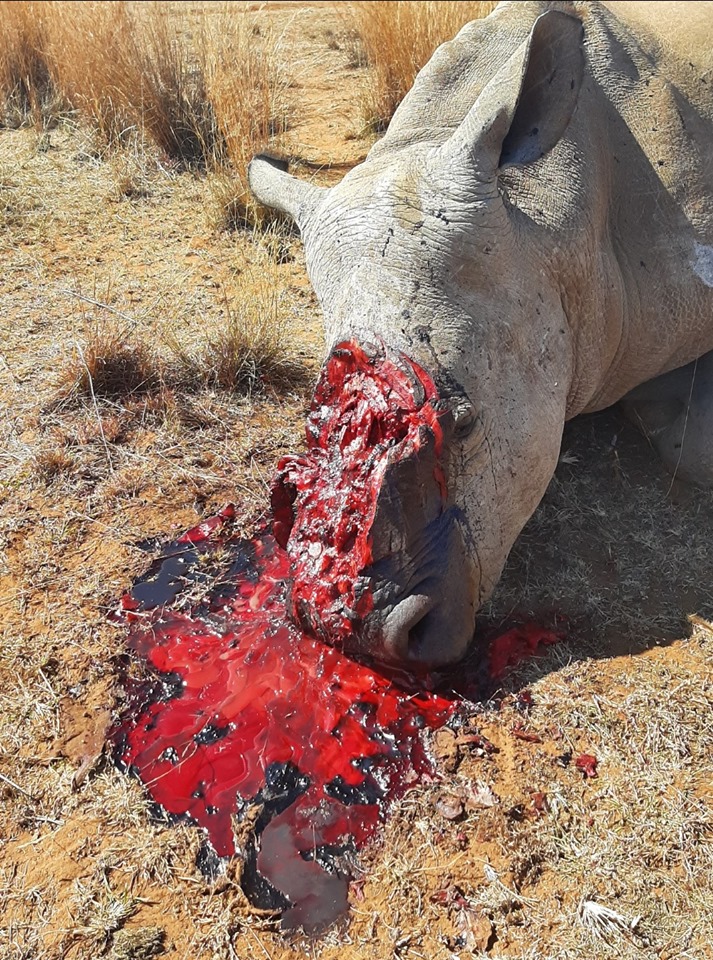
Rhino horn is worth some $US65,000 a kilogram as part of this illicit trade - while gold sells at the time of writing for $51,000. In Niassa, black rhinos are all but gone. South Africa is home to in the region of 20,000 rhinos, black and white. That is virtually ninety percent of the remaining population. There is some semblance of enforcement there still, with a Thai national, Chumlong Lemtongthai, recently having been sentenced to forty years in prison for trafficking in horn, and a number of poachers having died in firefights with the authorities - but still the annual slaughter of rhino there hovers just below the 500 mark.

Be it rhino or elephant, everyone from al-Qaeda to the Lord’s Resistance Army is in on the game, with AK-47s, heavy machineguns and anti-tank mines. During his African wanderings in 2009, Mander saw firsthand the regional anti-poaching efforts. He offered his expertise, but he was an outsider and an unknown quantity. His military background - exactly what they needed - put many of them off because they were no doubt mindful of being seen in the wrong light by their governments. Mander was quoted : "I was walking through the bush one day [in Zimbabwe] and I came across an elephant with its face missing," he explains. "That was it. When I saw that animal poached, it hit me in the face like nothing has ever hit me before. I don't know what Iraq had done to me, but I wasn't the same." This galvanized him to liquidate a number of investments which he had been cultivating over the years and establish the International Anti-Poaching Foundation.
He established a $100,000 training facility at Victoria Falls. From there he branched out into South Africa and Mozambique. Far from propagating an aggressive militaristic approach, his training emphasizes alternate approaches to arresting poachers, and not gunfights. Whenever possible.
Mander’s First World approach has resulted in a large amount of donor funding being generated from sectors that had become tired of contributing toward the lose-lose situation of African causes, and he has also attracted a small army of volunteers - but rather than fitting the gung-ho mercenary image his detractors have crafted for him, what he offers is training.

The gold standard – the best of the best – was offered by the late Rory Young’s (KIA in Burkina Faso in 2021) Cengeta Wildlife, but Mander also has a good approach.
Training for local anti-poaching operators who lacked the skills and equipment to carry out their mandate to maximum effect, and a character-building learning experience for young people from overseas who benefit from the boot camp approach to IAPF organisation. The most sinister by product of Mander’s military style philosophy seems to be self-discipline. Still, Mander is a foreigner with crack special forces backgrounds, operating a paramilitary-style NGO operation in a country where the security forces have been implicated in poaching operations for over forty years. It was difficult for Mander to cultivate a relationship with the authorities, but from the onset he was open and above-board about what he was trying to achieve. Because of this policy of transparency, Mander says : “We've been asked lots of questions by all sections of the authorities and they're fine."
Conservation initiatives are great for developing countries because they bring in donor funding. So words like “transparency” and “enforcement” are oft-heard bandied about. The result is that there is a vigorous prosecution of offenders up to a certain pay grade, beyond which are the Untouchables - the connected. It is unlikely that IAPF initiatives will get too close to that lofty clique, but as Mander says “We live in the bush. If somebody wants to come and have a crack at us, they can.”
The response to IAPF initiatives varies from country to country. Mozambique has allowed the use of small unmanned drone aircraft. Especially in Africa, drones can cover vast tracts of land that would be next to impossible to effectively patrol on foot (but oddly enough there is very little data on successful proof of concept). This means that the anti-poaching teams can become QRFs - quick reaction forces - responding to specific threats instead of squandering manpower on fruitless games of hide-and-seek. Zimbabwe has declined to allow the use of drones.

Projects like the IAPF seem to me to be the perfect solution. Damien Mander was quoted as saying “I’m often asked how I can focus so hard on protecting animals when there are people suffering around the world. I ask them if they would have more of a problem with a dog digging up their flower bed, or a terrorist launching a chemical attack in their city centre. Both are at about the extreme levels of what animals and humans are intentionally capable of doing to really upset your day. Over the past few years I have really started to struggle on a personal level with the way things are unfolding on a global scale. We now share a planet with seven billion other people, all fighting hard each day for a better job, to build a grander house and drive a faster car. We spend more each waking moment to advance, to grow bigger, faster and stronger. We spend more protecting our own species than anything else on the planet. We no longer live in a society; we live in an economy. In the short-sightedness of our quest to advance, we have foolishly pushed ourselves to a point where we are scrambling for solutions. We need to decide what is important and then make decisions that matter. We are doing our best to hold back the tide of human encroachment, the unbalanced challenge between dwindling wilderness areas and rapidly increasing human populations. If we all don’t begin to respect this planet, and I mean wholeheartedly, then it is going to chew us up and spit us out.” He is right. Right about that, and right about the value of an initiative like the IAPF.

PHOTOS
1 - ZIMBABWE INTRODUCED A SHOOT-ON-SIGHT POLICY FOR POACHERS IN 1986
2- A RHINO AS FACELESS AS THE MEN WHO KILLED HIM
3- AN ANTI-POACHING UNIT ENGAGED THIS GANG BEFORE THE IVORY COULD BE HARVESTED. TWO POACHERS DIED
4 - INTERNATIONAL ANTI-POACHING FOUNDATION FOUNDER DAMIEN MANDER
5 - WHAT GAME WARDENS LOOK LIKE IN AFRICA - THE BUSH IS A WAR ZONE
6 - SOME, LIKE THIS OLD BOY, DIE OF NATURAL CAUSES. PHOTO MARK BRIGHTMAN
7 - THIS ELEPHANT WAS KILLED WITH CYANIDE-LACED ORANGES. PHOTO STEVE ALENXANDER
8 - A POACHER WHO PAID THE ULTIMATE PRICE WHEN HE FIRED ON AN ANTI-POACHING UNIT
9 - COVERT OPS ARE ALSO A BIG PART OF THE WAR ON POACHING - MORE ON THAT LATER
10 - SILVANA OLIVO'S EXCELLENT BOOK, WHICH I WILL REVIEW SOON
135 total views, 1 today

